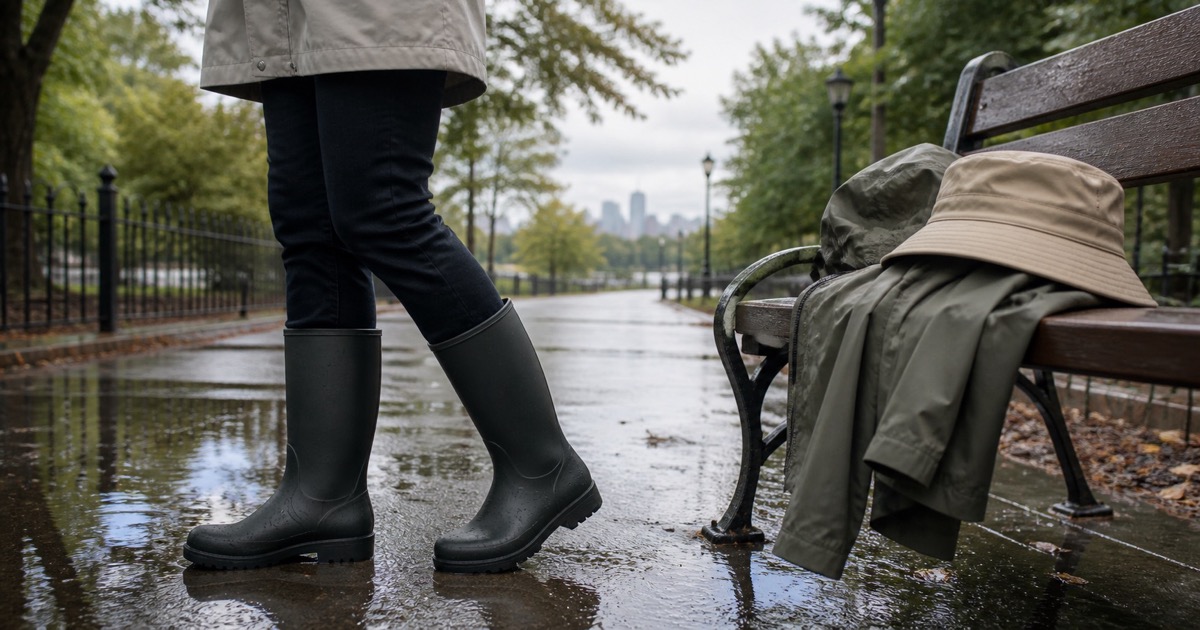
Wet park walks are often short enough to feel casual and long enough to reveal the weak point in an outfit. The shoes soak first, the hood blocks peripheral view, hair flattens under mist, or a heavy jacket feels excessive after ten minutes. Buying more rainwear does not solve that mismatch unless the reader knows which discomfort appears most often.
The practical choice is usually between three roles. Rain boots help when puddles, grass edges, and muddy paths are the problem. A rain hat helps when the reader wants light coverage without committing to a hood for the whole walk. A shell or rain jacket helps when drizzle, wind, or changing weather asks for a layer that can be worn or packed. The best answer may be one piece, not a full weather outfit.
This guide does not promise waterproofing, traction, visibility, warmth, or safety. Route surface, fit, weather, pace, personal mobility, and maintenance all change performance. Readers should check the forecast, park notices, product labels, and current retailer details before choosing gear for wet conditions.
Quick Answer
Choose rain boots first when the walk regularly includes puddles, wet grass, muddy entrances, dog-park edges, or saturated leaf piles. Compare shaft height, sole shape, calf or ankle fit, lining notes, weight, and storage space. The best pair is the one the reader will actually put on for a twenty-minute walk, not the pair that feels built for a storm the routine never sees.
Choose a rain hat when the main issue is light mist, hair coverage, or avoiding a hood for a short errand through the park. Choose a shell when the walk may shift from drizzle to steady rain, or when pockets and layering matter more than footwear. Start with the most frequent annoyance, then add the second piece only if the route keeps asking for it.
Shop the Edit
Elite Fashion may earn a commission from qualifying purchases made through shopping links on this page. Links are chosen for editorial fit and practical relevance to the article topic.
Start With the Route Underfoot
Before opening product listings, picture the exact path. Is it a paved loop, gravel shortcut, grass field, dog-walk route, school run, waterfront path, or cafe detour after rain? The surface tells the reader whether footwear is the first problem. A clean sidewalk may not need boots at all, while a familiar park entrance can stay wet long after the sky clears.
Distance matters too. Tall boots may feel logical for a muddy route, but they can become annoying on a fast urban walk if they are heavy, warm, or hard to store by the door. For a short routine, ease of use is part of the value. The piece that is quick to grab will beat the more dramatic option that stays in the closet.
When Men's Rain Boots Make Sense
Men's rain boots can be useful when the reader needs a straightforward pair for dog walks, school drop-offs, garage-to-park errands, or wet weekend paths. Compare shaft height, opening width, lining notes, sole description, pull tabs, weight, and whether the boot works with the pants normally worn on rainy mornings.
The style decision is practical. A matte black, olive, navy, or dark brown boot can sit quietly with a parka, chore jacket, denim, or jogger. A taller agricultural or work-style shape may be unnecessary for a paved city path. Avoid relying on a listing for traction or waterproof guarantees; instead, confirm materials, care instructions, returns, and route fit.
When Women's Rain Boots Fit the Walk
Women's rain boots vary from ankle styles to tall shafts, and the best choice depends on the outfit as much as the puddle. Compare calf fit, ankle height, opening shape, footbed notes, lining, sole profile, and whether the boot works with leggings, straight jeans, wide-leg trousers, or a casual skirt. A boot that fights the outfit may be skipped on the morning it is needed.
Storage should be part of the comparison. Tall boots need space to dry and stand without folding. Short boots may fit apartment entries, small closets, or car trunks more easily. If the reader walks mostly on sidewalks, a lower rain boot may solve the daily problem without taking over the entryway.
Use a Shell for Weather That Changes
A rain jacket or shell earns its place when the forecast moves between mist, drizzle, wind, and cooler shade. Compare length, hood shape, sleeve adjustment, pocket placement, zipper behavior, packability, care guidance, and whether the jacket layers over a sweater or light fleece already owned. The right shell should answer the walk, not overwhelm it.
For wet park routes, jacket length can matter more than a technical feature list. A slightly longer cut may cover more of the outfit when sitting on a damp bench or walking through brush, while a shorter packable shell may suit errands and travel better. Readers should use current product pages to confirm materials and intended use rather than assuming every jacket handles rain the same way.
Use a Rain Hat When a Hood Feels Like Too Much
A rain hat can be the quietest solution for a short wet walk. It keeps the head covered without trapping the outfit inside a full hood, and it can be easier to remove when stepping into a cafe, transit shelter, or office lobby. Compare brim width, crown shape, material notes, packability, color, and whether the hat works with glasses, headphones, or hair length.
Men's and women's rain-hat searches often overlap, but fit and styling cues still matter. A soft bucket shape may pack into a tote, while a broader brim may suit a slower park route. The hat should not be treated as a safety or visibility tool; it is a light coverage piece for readers who dislike hoods or want a less bulky answer to mist.
Build Three Wet-Walk Formulas
For a puddle-heavy dog walk, start with rain boots, a washable outer layer, and a hat only if the hood gets in the way. For a short city-park commute, start with a light shell, regular shoes if the sidewalks stay clear, and a packable hat in the bag. For a weekend stroll after steady rain, boots and a shell may work together, but the outfit should still be easy to clean and store afterward.
Each formula should end with a reset. Boots need a place to dry, hats need a spot where they will not crush, and shells need care according to their label. If the item creates a mess after every walk, it is not solving the routine. Wet-weather pieces are most useful when they make leaving and returning home easier.
Check Care and Returns Before Buying
Rainwear depends heavily on materials, construction, fit, and care. Before buying, confirm sizing, shaft circumference, jacket length, hood details, washing instructions, drying guidance, return terms, and delivery timing on the retailer page. If the reader needs the piece for an upcoming trip or season change, timing matters as much as style.
After a few wet walks, review which discomfort remained. If feet stayed dry enough but the hood annoyed the reader, a hat may be the better second purchase. If the jacket stayed home because it was bulky, a lighter shell may be more useful than another boot. Let the route teach the next decision.
Comparison Points
| Piece | What to compare |
|---|---|
| Men's rain boots | Compare shaft height, opening width, sole shape, lining notes, weight, storage footprint, and pant pairing. |
| Women's rain boots | Compare calf fit, ankle height, opening shape, lining, sole profile, outfit pairing, and return terms. |
| Rain jacket | Compare length, hood shape, pocket placement, sleeve adjustment, packability, care guidance, and layering room. |
| Men's rain hat | Compare brim width, crown shape, packability, material notes, care instructions, and use with glasses or hoods. |
| Women's rain hat | Compare brim shape, hair-friendly fit, packability, color, care guidance, and whether it stores easily between showers. |
Use Cases
Dog walk after rain
Start with boots when the route includes grass, puddles, and muddy park entrances.
Cafe detour through the park
Use a packable shell or hat when the route is paved and the main issue is light drizzle.
Weekend wet-weather stroll
Combine boots and a shell only when both foot coverage and upper-body coverage solve repeated problems.
Before You Buy
For Rain Boots, Rain Hat, or Shell for Wet Park Walks, use retailer pages to confirm sizing, dimensions, materials, care instructions, color options, delivery timing, and return terms. The best choice is the one that fits the real routine and the real storage space, not the one that looks most complete in isolation.
After the first week of using the Rain Boots, Rain Hat, or Shell for Wet Park Walks setup, notice what was reached for, what stayed unused, and what made cleanup or storage harder. That small review is often more useful than adding another product before the routine has proved itself.
Browse Category Hubs
For Rain Boots, Rain Hat, or Shell for Wet Park Walks, use these broader category hubs after the article-specific product options. Narrow by size, material, format, care needs, delivery options, and the space available at home or work.
FAQ
Are rain boots necessary for short park walks?
Not always; choose them when puddles, wet grass, or muddy entrances are the repeated problem, and compare fit and storage before buying.
Is a rain hat better than a hood?
A rain hat can be better for light mist or readers who dislike hoods, but a shell may suit steadier rain or changing weather.
What should I check before buying rainwear online?
Confirm size, shaft or jacket measurements, care guidance, materials, return terms, and whether the item fits the route you actually walk.