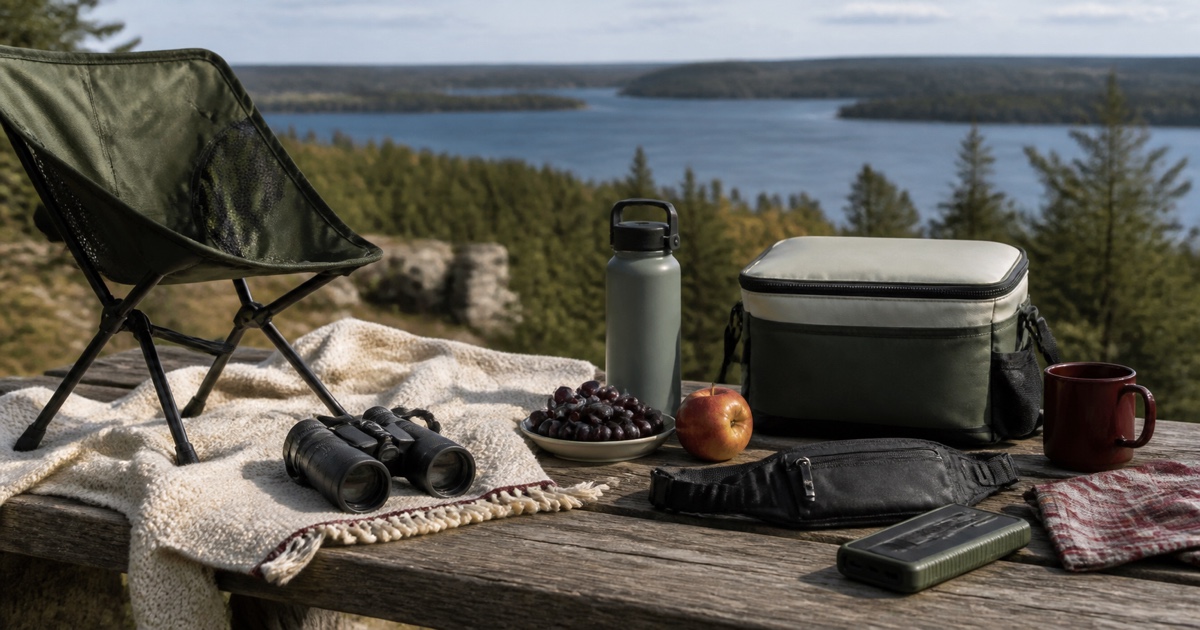
A Labour Day day trip can become overpacked very quickly. The forecast feels uncertain, the route has more stops than expected, and the car starts collecting backup layers, food containers, chargers, bottles, blankets, and objects that never leave the trunk. A better kit begins with the outing itself: one park path, one lookout, one picnic stop, and a clear return home before the gear turns into a weekend expedition.
For Canadian readers, early September usually asks for flexible decisions rather than heavy adventure planning. A compact chair can make a rocky viewpoint more pleasant, binoculars can slow down a scenic pause, a belt can keep small essentials reachable, a cooler can keep lunch contained, and a power bank can support ordinary phone use. None of these pieces should be treated as a rescue plan, route guarantee, wildlife tool, weather solution, or load-bearing promise.
Use this guide as a practical packing filter. Check park rules, road notices, fire restrictions, trail closures, parking limits, local weather, and manufacturer instructions before leaving. The goal is a day-trip setup that feels deliberate at each stop and simple to unpack when everyone gets home.
Quick Answer
For a September long-weekend day trip, pack one compact seating option, one small observation piece, one on-body carry piece, one cooler sized for the food actually being brought, and one charged power bank with the right cables. Keep the rest of the kit in the car only if it has a clear job for the planned route.
The cleanest setup separates the day into moments: movement, pause, lunch, and reset. A running belt handles movement, binoculars and a chair support the pause, the cooler keeps food together, and the power bank stays with cables in a small pouch. If an item does not serve one of those moments, it probably belongs at home.
Shop the Edit
Elite Fashion may earn a commission from qualifying purchases made through shopping links on this page. Links are chosen for editorial fit and practical relevance to the article topic.
Start With the Route Rules
Before comparing gear, check whether the park, lookout, picnic area, ferry stop, or provincial site has rules that change the plan. Some areas restrict where chairs can sit, whether food can be left unattended, where coolers belong, and how long visitors can remain at a viewpoint. Gear should support the outing, not create extra decisions at the entrance.
A simple route map also prevents overpacking. If the day is mostly a paved path and a picnic table, a large outdoor loadout is unnecessary. If the plan includes a short gravel trail, a windy lookout, or several stops where the group leaves the car, the kit should be easier to carry and faster to repack.
Let the Chair Earn Its Space
A backpacking chair is useful when the day includes waiting, scenic sitting, or a picnic area without reliable benches. Compare packed length, weight, carry bag, seat height, and how quickly it can be set up and put away. For a day trip, the best chair is often the one people will actually bring from the car.
Avoid buying the largest chair because it looks more comfortable in isolation. The September day-trip chair has to share space with food, layers, and other people's bags. It should work for a short lookout pause or a field-edge lunch, then disappear back into the trunk without turning cleanup into another project.
Use Binoculars for Slower Stops
Binoculars make sense when the group enjoys slower observation: shoreline views, distant boats, ridgelines, birds seen from a public area, or a city lookout. Compare magnification, field of view, size, case, and strap behavior. A compact pair that comes out for ten minutes may be more useful than a larger pair left at home.
Do not frame binoculars as a wildlife guarantee or navigation tool. They are a way to notice detail from a respectful public distance. Readers should follow local wildlife guidance, stay on marked routes, and avoid using gear as a reason to approach animals, restricted zones, or unsafe edges.
Keep Small Items On the Body
A running belt can be useful even when no one is running. For a day trip, it can hold a phone, card, key, lip balm, transit pass, small sunscreen tube, or folded park receipt while larger bags stay in the car or at the picnic table. Compare pocket size, zipper behavior, strap adjustment, and whether the belt works over a light layer.
The belt should reduce friction, not replace common sense. It does not prevent theft, protect valuables, or make a route safer. Its value is reach: the things needed at the parking meter, washroom, trailhead sign, or lookout should not be buried under lunch containers.
Size the Cooler to the Meal
A cooler is often where day trips get too large. Start with the meal: sandwiches, fruit, drinks, small containers, and whatever needs to return home. Compare internal size, handle style, cleaning routine, and whether the cooler can sit behind a seat without blocking other bags.
Do not rely on a cooler listing for food-safety decisions. Pack perishable items according to public health guidance and product instructions, and keep the menu simple when the day is built around movement. A good day-trip cooler is easy to clean when the group returns, not just impressive before leaving.
Pack Power Without Making Claims
A rugged power bank can support ordinary phone use, maps already downloaded, tickets, photos, and messages when the day runs longer than planned. Compare capacity, port mix, cable storage, case texture, and how the manufacturer describes charging and care. Charge it before the trip and pack the specific cables needed.
This is not a navigation guarantee, emergency plan, or substitute for telling someone the route. It is a practical backup for modern day-trip friction. Keep expectations modest, and avoid building the outing around a device that has not been tested with the phone and cable at home.
Build the Car-to-Picnic Reset
The best kit is easy to reset at every stop. Put belt items in the same pocket, keep binoculars in their case, return food containers to one cooler, and give the chair a predictable trunk position. The car should not become a loose pile by the third stop.
At home, unpack the cooler first, wipe the chair if needed, recharge the power bank, and return the belt and binoculars to the same shelf. That reset is what makes the kit ready for the next late-summer outing without another shopping session.
Comparison Points
| Piece | What to compare |
|---|---|
| Backpacking chair | Compare packed size, seat height, carry bag, setup steps, and whether it fits the real stop pattern. |
| Binoculars | Compare size, strap, case, magnification, and whether slower observation is part of the group plan. |
| Running belt | Compare phone fit, pocket layout, strap adjustment, and reach during parking, paths, and picnic stops. |
| Cooler | Compare internal size, handle style, cleaning routine, and how simply it returns home. |
| Rugged power bank | Compare port mix, cable needs, manufacturer care guidance, and how it stores with the day-trip kit. |
Use Cases
Park path plus lookout
Use the belt for phone and keys, keep binoculars reachable, and leave the chair packed until the scenic pause.
Picnic-first afternoon
Size the cooler around the meal and put the chair closest to the trunk opening for quick setup.
Multi-stop drive
Keep each object in a repeatable place so the car stays orderly after parking, viewing, eating, and returning.
Before You Buy
Use retailer pages to confirm sizing, dimensions, materials, care instructions, color options, delivery timing, and return terms. The best choice is the one that fits the real routine and the real storage space, not the one that looks most complete in isolation.
After the first week of use, notice what was reached for, what stayed in the drawer, and what made cleanup harder. That small review is often more useful than adding another product before the routine has proved itself.
Browse Category Hubs
Use these broader category hubs after the article-specific product options. Narrow by size, material, format, care needs, delivery options, and the space available at home or work.
FAQ
What should I pack for a Labour Day day trip?
Start with route-specific basics, then add compact seating, binoculars if scenic stops matter, a small carry piece, a modest cooler, and a charged power bank with cables.
Do I need a full hiking backpack for a park and picnic day?
Often no. If the route is short and car-based, a running belt plus a small shared tote or cooler may be enough.
How do I avoid overpacking for a September long weekend outing?
Match each item to a stop: movement, lookout, picnic, or reset. If an item does not serve one of those moments, leave it out.