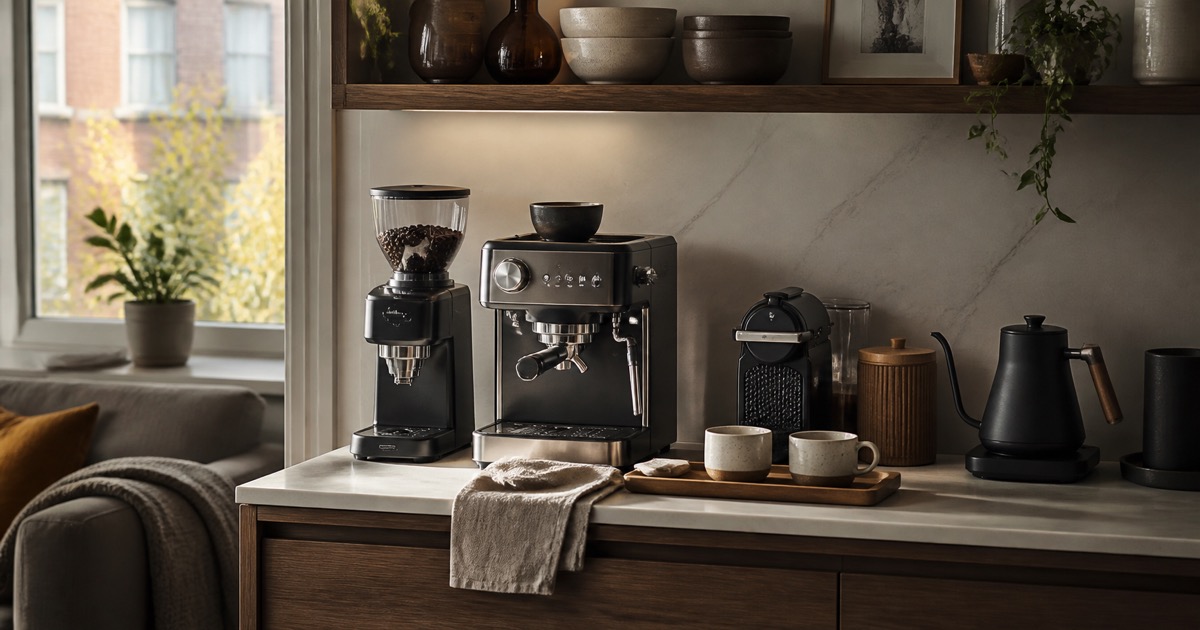
A small-space coffee station starts as a pleasant idea and can become counter clutter almost immediately. The grinder stays beside the outlet, the espresso machine claims the deepest corner, capsule boxes stack near the mugs, the kettle needs its own base, and suddenly the slow morning feels more crowded than the routine it was meant to improve.
The solution is not to buy every coffee format. It is to choose one main path, one support tool, and a storage rhythm that fits the apartment, condo, dorm, or compact kitchen. A grinder and espresso machine support a hands-on routine. A capsule system supports speed and predictability. A gooseneck kettle supports pour-over or tea-adjacent mornings. Mug sets only help when they simplify the cabinet rather than multiply it.
This guide avoids taste, brewing quality, speed, pressure, energy, or longevity guarantees. Product pages should be checked for dimensions, materials, care instructions, electrical requirements, return terms, and current availability. The useful decision is about workflow, footprint, cleanup, and household fit.
Quick Answer
Choose one primary coffee path before buying accessories. If the household enjoys measuring, grinding, and adjusting, compare a burr grinder and espresso machine by footprint, cleaning routine, and counter access. If the household needs a faster start, compare a capsule system by machine size, pod storage, and cleanup. Add a gooseneck kettle only if pour-over, tea, or a controlled hot-water routine already happens.
Finish the station with a small mug set that fits the cabinet and supports the actual number of drinkers. A tray, drawer divider, or narrow shelf can help, but only after the main equipment has a measured home. The best small-space station looks calm because it has fewer decisions, not because it displays every possible coffee tool.
Shop the Edit
Elite Fashion may earn a commission from qualifying purchases made through shopping links on this page. Links are chosen for editorial fit and practical relevance to the article topic.
Measure the Counter Before Choosing the Machine
Counter depth is the first constraint. Many small kitchens have outlets in awkward places, shallow corners, upper cabinets that limit height, or a sink path that turns every morning into a reach around. Measure width, depth, clearance under cabinets, and the distance to the outlet before comparing machines. A coffee station that blocks prep space will feel irritating even if the coffee ritual is pleasant.
Also measure the storage around the station. Beans, filters, pods, mugs, cleaning cloths, scoops, and small accessories need a home. If those pieces float loose on the counter, the station will expand beyond its intended footprint. A compact system succeeds when the supporting items disappear easily after use.
Decide Whether Grinding Is Part of the Ritual
A burr grinder can be the right anchor for readers who enjoy a more hands-on routine, but it adds footprint, sound, cleaning, and bean storage. Compare hopper size, grind setting controls, grounds container access, cleaning guidance, and whether the grinder can stay out without crowding the prep area. If it has to be moved every morning, the ritual may become tiring.
Pair the grinder decision with the brewing method. Buying a grinder because it feels serious does not help if the household usually wants a fast mug before leaving. It belongs when the routine already values control, repeatability, and a few extra steps. Otherwise, the grinder may be a better future upgrade than a first purchase.
Compare Espresso Machines by Routine, Not Promise
An espresso machine can make a compact kitchen feel intentional, but it also asks for space around the water tank, drip tray, portafilter, milk accessories, cleaning tools, and sometimes a knock box or towels. Compare the full setup, not just the machine body. A machine that barely fits may still be frustrating if the water tank cannot be removed easily.
Avoid treating product names as guarantees about drink quality, pressure, speed, or longevity. Those claims depend on setup, maintenance, beans, user skill, and manufacturer details. A better comparison asks whether the machine's routine fits weekday mornings, weekend pacing, and the amount of cleanup the household will actually do.
Use Capsules When Convenience Is the Real Priority
A capsule system can be a sensible small-space choice when the household values quick preparation, predictable cleanup, and a narrow equipment footprint. Compare machine width, water tank access, used-capsule storage, pod organization, and whether the machine can sit on a tray with the mugs or supplies nearby.
The tradeoff is storage and ongoing supply. Pods need a disciplined location, or the station quickly becomes a stack of boxes. Before buying, decide whether capsules will live in a drawer, a vertical organizer, or a small basket that disappears into the cabinet. Convenience works best when the storage is also convenient.
Add a Gooseneck Kettle Only With a Clear Job
A gooseneck kettle is useful when pour-over coffee, tea, or controlled hot-water use is already part of the household rhythm. Compare base size, spout shape, handle angle, lid behavior, cord storage, and controls listed on the retailer page. If the kettle only looks good beside the machine, it may be borrowing counter space from a tool used every day.
The kettle also changes the station layout. It needs room near water, a safe landing place after use, and enough clearance that the handle does not bump mugs or shelves. In a very small kitchen, a kettle kept in a cabinet may be better than a permanent countertop object.
Let Mugs Reduce Visual Noise
A coffee mug set is not just decoration. In a compact kitchen, matching or coordinated mugs can reduce visual clutter if they stack well, fit the cabinet, and suit the drinks actually made. Compare capacity, handle comfort, material, weight, dishwasher guidance, and whether the set includes more pieces than the household needs.
Too many mugs make the station feel less calm. Keep the everyday set close to the machine or kettle, then move sentimental or occasional mugs somewhere else. The slow-morning feeling comes from a cleaner reach: cup, coffee path, small towel, and a place to reset.
Build a Reset That Takes Two Minutes
A small-space coffee station should reset quickly. Grounds, pods, drips, mugs, towels, and water marks should have an obvious next step. If the station requires a larger cleaning session after every cup, it will not feel slow or restful for long. Compare products by how easily they return to a quiet surface.
Before buying, check current dimensions, materials, care guidance, electrical details, and return terms. Then decide what leaves the counter if the new piece arrives. In a small kitchen, every added object should either replace a harder routine or make the existing routine easier to repeat.
Comparison Points
| Piece | What to compare |
|---|---|
| Coffee grinder | Compare footprint, hopper size, controls, cleaning access, noise expectations, and whether grinding is part of the morning ritual. |
| Espresso machine | Compare counter depth, water tank access, cleaning routine, accessory storage, and whether the setup fits weekdays. |
| Capsule system | Compare machine size, pod storage, cleanup rhythm, water access, and whether convenience is the main priority. |
| Gooseneck kettle | Compare base size, spout shape, handle angle, controls, cord storage, and whether pour-over or tea repeats. |
| Coffee mug set | Compare stackability, cabinet fit, handle comfort, material, size, and whether the number of mugs reduces clutter. |
Use Cases
Apartment weekday mornings
Choose one compact machine path and keep beans, pods, or mugs in a drawer or tray that resets quickly.
Weekend espresso ritual
Use a grinder and espresso machine only when the extra measuring, cleaning, and accessory storage feel worthwhile.
Tea and pour-over household
Let the gooseneck kettle take priority only when controlled hot water is part of the repeated routine.
Before You Buy
Use retailer pages to confirm sizing, dimensions, materials, care instructions, color options, delivery timing, and return terms. The best choice is the one that fits the real routine and the real storage space, not the one that looks most complete in isolation.
After the first week of use, notice what was reached for, what stayed in the drawer, and what made cleanup harder. That small review is often more useful than adding another product before the routine has proved itself.
Browse Category Hubs
Use these broader category hubs after the article-specific product options. Narrow by size, material, format, care needs, delivery options, and the space available at home or work.
FAQ
What belongs in a small coffee station?
Start with one primary coffee path, one support tool if it has a clear job, a restrained mug set, and storage for beans, pods, towels, or filters.
Should I choose espresso or capsules for a small kitchen?
Choose espresso when you want a hands-on routine and have room for cleaning and accessories; choose capsules when convenience, speed, and simpler cleanup matter more.
Is a gooseneck kettle necessary?
Only if pour-over coffee, tea, or controlled hot-water use already happens often enough to justify the counter or cabinet space.