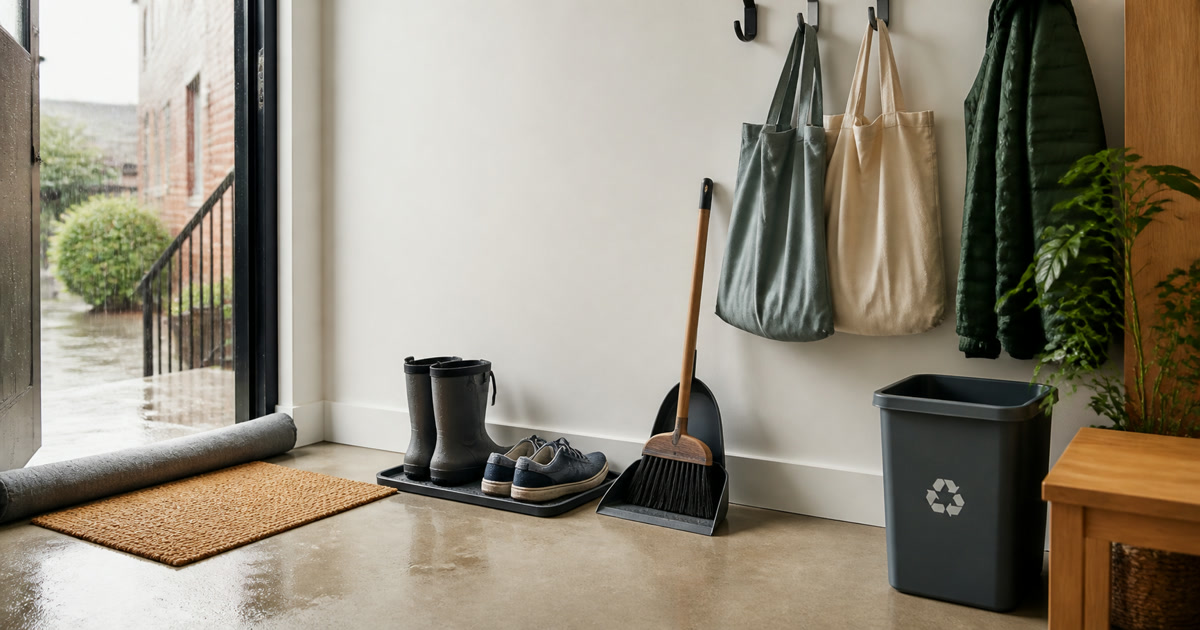
Rain changes the entryway faster than any other part of a small home. Shoes arrive damp, bags land on the floor, grocery totes pile up near the door, recycling waits for the next trip out, and the first few steps inside start to feel like a sorting station. The issue is not that the household owns the wrong objects. It is that the objects do not have a clear sequence.
A better entryway reset assigns jobs: one landing surface for wet shoes, one visible place for reusable bags, one cleanup tool for small debris, one compact recycling rhythm, and one door-gap item if the doorway genuinely needs it. Each piece should reduce a repeat decision rather than create another thing to move before leaving the house.
This guide avoids slip-prevention, weather-sealing, pest-control, sanitation, and performance promises. Product pages can help compare dimensions, materials, care instructions, and return terms, but every doorway, floor surface, and household routine is different.
Quick Answer
Start with the path from door to kitchen. Place a low-profile washable mat where wet shoes actually land, store reusable grocery bags on a hook or narrow shelf near the exit, keep a broom and dustpan within reach for grit, give recycling a compact container that does not block the door, and use a door draft stopper only after confirming the gap and door movement.
The entryway should not become a decorative storage project. It works when every item has a job in the first two minutes after coming home and the last two minutes before leaving. If a product does not support that handoff, it probably belongs somewhere else.
Shop the Edit
Elite Fashion may earn a commission from qualifying purchases made through shopping links on this page. Links are chosen for editorial fit and practical relevance to the article topic.
Begin With the Drop Zone
Stand inside the door and notice where shoes, keys, groceries, and mail naturally land. A reset that fights the real landing spot usually fails. The goal is to make the existing behavior neater: a mat where shoes pause, a hook where bags return, a bin where recycling waits, and a tool that handles the small mess before it spreads.
Measure before buying. Door swing, closet depth, floor transition, hallway width, and stroller or cart movement can all change what fits. In a narrow apartment entry, a smaller piece that never blocks the door is better than a larger piece that looks complete online.
Use a Mat as a Boundary, Not a Promise
A bath mat or washable mat can create a soft boundary for wet shoes, umbrellas, or a grocery tote that needs a moment before reaching the kitchen. Compare footprint, pile height, backing, wash instructions, drying time, and how it behaves with the door swing. Avoid relying on a mat as a universal safety or floor-protection guarantee.
Color and texture still matter because the mat is one of the first visible surfaces in the home. A darker neutral can hide daily visual noise, while a lighter one may make the entry feel calmer if it is easy to wash. Choose the version that supports cleaning habits rather than the one that only photographs well.
Give Grocery Bags a Return Point
Reusable grocery bags are useful only when they make it back to the exit. Compare handle length, foldability, material, and whether the set can live on a hook, in a basket, or inside one parent bag. The best system is the one that makes grabbing bags automatic before the next grocery run.
Avoid keeping every promotional tote. Select the few that match the household's actual shops: a sturdier bag for pantry items, a foldable one for unplanned errands, and perhaps a smaller option for pharmacy or market trips. Too many bags make the entryway feel busy and make the good ones harder to find.
Keep Cleanup Small and Immediate
A broom and dustpan near the entry can stop grit, leaves, and crumbs from traveling through the home. Compare upright storage, brush width, dustpan lip, handle height, and whether the set can stand in a closet corner or behind the door without falling forward. The tool should be easy to use for thirty seconds, not only during a full cleaning session.
This is a practical design choice as much as a cleaning choice. If the broom looks too industrial for the only visible corner, it may be hidden too far away and never used. A compact set that stays reachable often beats a larger set stored in another room.
Make Recycling Part of the Exit Routine
A recycling bin near the entry helps only when it supports the household's actual flow. Compare footprint, lid style, liner fit, carrying handles, and whether the bin is easy to empty on the way out. For some homes, a narrow bin near the door works; for others, a kitchen bin with an exit-day staging spot is cleaner.
The entryway version should not invite every package and paper to live at the door. Set a simple rule: only items leaving the home soon belong there. Everything else should be flattened, sorted, or moved to the main recycling area so the entry stays calm.
Check Door Gaps Without Overpromising
A door draft stopper can be worth comparing when a visible gap creates a comfort issue, but it should be treated as a fit item, not a guaranteed seal. Compare length, attachment style, fabric, cleaning guidance, and whether the door can still open and close normally. Door materials, thresholds, and installation details all matter.
If the stopper slides, bunches, or blocks the door, it will become another thing to kick aside. The right choice is quiet and boring: it fits the doorway, can be cleaned as instructed, and does not interfere with daily exits.
Build a Ten-Minute Weekly Reset
Once a week, return bags to the hook, shake or wash the mat according to care instructions, empty the recycling container, stand the broom back in its spot, and check whether shoes have started to multiply. The point is not perfection. It is preventing the entry from becoming a storage zone by default.
The best rainy-day entryway feels modest. It helps the household arrive, unload, clean a small mess, and leave again without turning every return home into an organizing project.
Comparison Points
| Piece | What to compare |
|---|---|
| Bath mat | Compare footprint, pile height, backing, drying needs, care guidance, and whether the door clears it. |
| Reusable grocery bags | Compare foldability, handle length, storage method, material, and whether bags return to the exit. |
| Broom and dustpan | Compare upright storage, brush width, dustpan lip, handle height, and visible placement. |
| Recycling bin | Compare footprint, lid behavior, liner fit, carrying handles, and exit-day emptying routine. |
| Door draft stopper | Compare length, attachment, fabric, cleaning guidance, and fit without promising complete sealing. |
Use Cases
Rainy weekday commute
Use the mat for wet shoes and keep the broom reachable so grit is handled before it reaches the living area.
Recurring grocery runs
Store a small set of reusable bags at the exit so the system supports leaving, not just returning.
Small apartment hallway
Choose narrow pieces that do not block the door swing, closet, cart path, or recycling routine.
Before You Buy
Use retailer pages to confirm sizing, dimensions, materials, care instructions, color options, delivery timing, and return terms. The best choice is the one that fits the real routine and the real storage space, not the one that looks most complete in isolation.
After the first week of use, notice what was reached for, what stayed in the drawer, and what made cleanup harder. That small review is often more useful than adding another product before the routine has proved itself.
Browse Category Hubs
Use these broader category hubs after the article-specific product options. Narrow by size, material, format, care needs, delivery options, and the space available at home or work.
FAQ
What belongs in a rainy-day entryway?
A landing mat, a small bag-return system, reachable cleanup tool, compact recycling plan, and only door-gap items that fit the actual doorway.
Can a bath mat work near the front door?
It can be considered when dimensions, care instructions, backing, and door clearance fit the space, but it should not be treated as a safety promise.
How do I stop reusable bags from piling up?
Keep only the bags used most often, store them inside one visible parent bag or on a hook, and return them during a weekly reset.