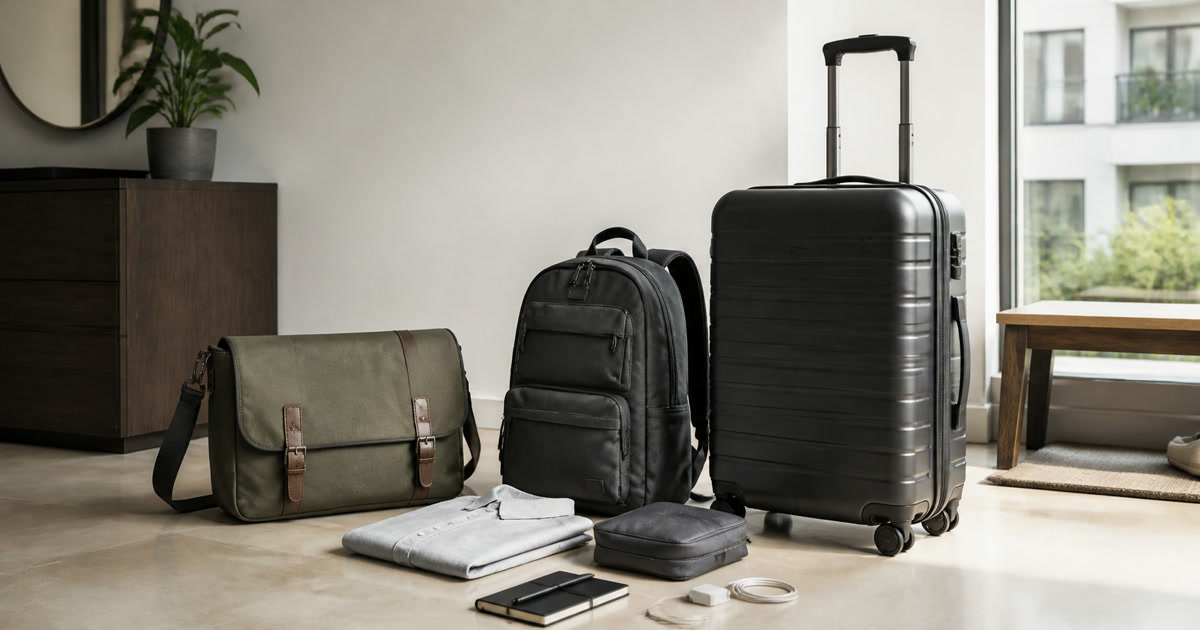
A one- or two-night work trip sounds simple until the packing list has to cover a laptop, charger, meeting clothes, toiletries, a change of shoes, weather shifts, and the items that keep the return day from becoming messy. The problem is not only how much a bag can hold. It is how clearly the bag supports the sequence of leaving home, moving through transit, arriving at a meeting, checking into a hotel, and returning with laundry or paperwork.
Carry-on luggage, a messenger bag, and a business backpack each solve a different version of the same trip. The carry-on separates clothing and toiletries better. The messenger bag keeps the workday silhouette sharper. The backpack spreads weight across both shoulders and can be easier when the route includes walking or public transit. A luggage set or gym bag can help in specific households, but neither should be treated as an automatic upgrade.
This guide avoids airline compliance, theft-prevention, waterproofing, capacity, and durability guarantees. Readers should always verify carrier size rules, workplace expectations, hotel storage, and retailer dimensions before buying. The useful question is which format reduces friction for the actual itinerary.
Quick Answer
Choose a carry-on when the trip includes a change of clothes, shoes, toiletries, and a clean separation between work items and overnight items. Choose a messenger bag when the trip is meeting-heavy, lightly packed, and mostly urban. Choose a business backpack when the route includes walking, train platforms, stairs, or a laptop setup that needs balanced carrying.
A luggage set makes sense only if the reader also needs a larger case for future trips and has room to store the set at home. A gym bag is useful as a secondary soft bag for shoes, laundry, or a casual return day, but it should not replace a structured work bag when a laptop and documents need predictable access.
Shop the Edit
Elite Fashion may earn a commission from qualifying purchases made through shopping links on this page. Links are chosen for editorial fit and practical relevance to the article topic.
Map the Trip Before Choosing the Bag
Start with the schedule rather than the product category. A one-night trip with one client meeting, a hotel stay, and a morning return asks for different access than a two-night trip with dinner, a site visit, and a remote-work block. Write down the moments when the bag will be opened: security or transit, office arrival, hotel check-in, dinner, morning repack, and the commute home.
The best bag format is often the one that makes those moments less awkward. A carry-on can keep clothing flat and toiletries contained, but it may feel excessive for a single overnight. A messenger bag keeps the laptop reachable but can become crowded if it also holds folded clothes. A backpack can handle movement well, but it has to look appropriate in the rooms the reader actually enters.
When a Carry-On Is the Better Primary Bag
A carry-on becomes useful when the trip has enough wardrobe change to justify hard-sided or structured separation. Compare external dimensions, interior compartments, handle height, wheel style, zipper behavior, and whether the case can be lifted and stored by the person using it. Always confirm current carrier limits and retailer measurements because rules and product dimensions can vary.
The carry-on also changes how the work bag behaves. If clothes, toiletries, and shoes live in the case, the messenger bag or backpack can stay focused on laptop, notebook, charger, wallet, and small essentials. That split is often cleaner than asking one soft work bag to handle every part of the trip.
When a Messenger Bag Looks More Intentional
A messenger bag is strongest when the trip is compact and the workday matters more than the overnight portion. Compare laptop sleeve dimensions, strap adjustability, top closure, front-pocket access, and whether the bag keeps a polished shape when it carries a charger, documents, headphones, and a small personal kit.
The tradeoff is packing discipline. A messenger bag can look sharp at a client lunch, but it may not be pleasant if it is also holding a second shirt, shoes, and toiletries. Use this route when clothing can stay minimal, the hotel is close, or the reader has a separate small case for overnight items.
When a Business Backpack Is the Practical Choice
A business backpack earns its place on routes with walking, stairs, public transit, or a heavier laptop setup. Compare strap shape, laptop access, front pockets, bottle placement, back-panel structure, and whether the silhouette stays clean enough for the workplace. The goal is not a technical hiking look; it is practical carry that still reads professional.
Backpacks can become clutter traps when every pocket is treated as storage. Before buying, imagine where the laptop, charger, toiletry pouch, notebook, keys, wallet, and travel documents will go. If the layout makes those answers obvious, the bag is more likely to help on a short trip.
Where Luggage Sets and Gym Bags Fit
A luggage set can be useful for households that already travel in several formats, but it is not automatically better for short work trips. Compare nesting, storage footprint, wheel and handle consistency, and whether each case has a clear future role. If only the smallest case will be used, a full set may create closet clutter.
A gym bag is best as a flexible secondary piece: shoes, workout clothes, laundry, or casual layers. It should be compared by opening style, strap comfort, separation pockets, and whether it can sit with the main work bag without making the traveler look overloaded.
Build Three Packing Formulas
For a meeting-heavy overnight, pair a compact carry-on with a slim messenger bag so clothing and work items stay separate. For a train-based two-night trip, use a business backpack with a small carry-on so the laptop remains reachable while clothes stay organized. For a casual site visit, a backpack plus a gym bag may work when shoes or outer layers need a separate home.
Each formula should leave room for the return journey. Receipts, laundry, a folded shirt, and a half-used toiletry pouch all take more space than the outbound version of the same trip. A good bag plan accounts for the less tidy return instead of only the clean packing photo.
Check the Details Before Checkout
Before buying, confirm current dimensions, weight, materials, laptop-sleeve measurements, care guidance, warranty or return terms, and delivery timing on the retailer page. For travel, confirm airline or train rules directly with the carrier. For office use, consider the workplace setting and whether the bag still looks right beside the outfit planned for the most important meeting.
The best short-trip bag is not the biggest or most technical option. It is the format that makes the calendar easier to move through, keeps the workday items reachable, and returns home without leaving the closet with another bag that has no clear role.
Comparison Points
| Piece | What to compare |
|---|---|
| Carry-on luggage | Compare dimensions, wheels, handle height, internal dividers, lifting comfort, and carrier rules before travel. |
| Messenger bag | Compare laptop sleeve, strap width, closure, front-pocket logic, and how the bag looks in meeting settings. |
| Business backpack | Compare laptop access, strap shape, pocket layout, profile, and whether it supports walking or transit. |
| Luggage set | Compare nesting, storage footprint, future trip roles, and whether every piece will actually be used. |
| Gym bag | Compare opening, shoe or laundry separation, strap behavior, and whether it is secondary rather than overloaded. |
Use Cases
One-night client meeting
Use a carry-on for clothes and a messenger bag for laptop and documents when the workday needs a sharper silhouette.
Two-night transit-heavy route
Use a business backpack for balanced laptop carry and a compact case for the overnight pieces.
Return day with laundry or shoes
Use a gym bag only when the soft extra space has a clear job and does not replace the work bag.
Before You Buy
Use retailer pages to confirm sizing, dimensions, materials, care instructions, color options, delivery timing, and return terms. The best choice is the one that fits the real routine and the real storage space, not the one that looks most complete in isolation.
After the first week of use, notice what was reached for, what stayed in the drawer, and what made cleanup harder. That small review is often more useful than adding another product before the routine has proved itself.
Browse Category Hubs
Use these broader category hubs after the article-specific product options. Narrow by size, material, format, care needs, delivery options, and the space available at home or work.
FAQ
Is a carry-on too much for a one-night work trip?
Not if the trip includes spare shoes, toiletries, and clothing that needs separation, but readers should confirm dimensions and carrier limits before travel.
Is a messenger bag or backpack better for a laptop?
A messenger bag can look more polished for light loads, while a business backpack often works better for walking, stairs, or a heavier laptop setup.
Should I buy a luggage set for short work trips?
Only if the other cases have clear future roles and storage space at home; otherwise a single well-chosen carry-on may be simpler.