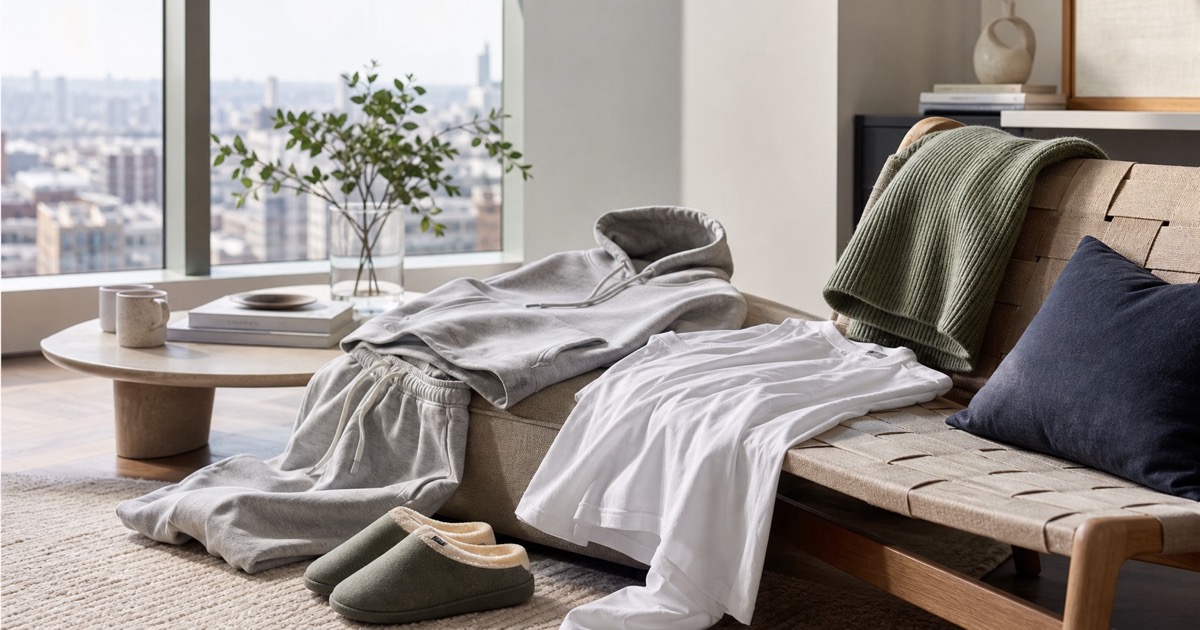
An at-home uniform becomes useful when it stops pretending that home clothes are invisible. The pieces may be soft, washable, and easy, but they still frame how a reader answers the door, joins a video call, steps out for coffee, or moves through a shared apartment. The goal is not to dress up the sofa. It is to make ordinary home hours feel less improvised.
The most reliable system starts with a base layer, a warmer top layer, a pair of joggers or relaxed pants, and slippers or house shoes that have a real place near the entry. Each piece should have a reason to be there: warmth, coverage, shape, laundry resilience, or quick-errand readiness. When the reasons are clear, the uniform feels calm rather than lazy.
This guide compares fabric role, pocket behavior, laundry frequency, layering, quick-errand usefulness, and whether pieces can leave the apartment. It does not promise comfort, performance, body outcomes, or durability. Readers should confirm size charts, fabric content, seller details, care instructions, return terms, and current availability on retailer pages before buying.
Quick Answer
Build the uniform with one clean base tee, one hoodie or knit layer, one pair of joggers with enough structure for a hallway or coffee run, and slippers that are easy to store by the door. Keep colours quiet enough to mix, but add one tonal contrast so the outfit does not become a single flat block.
The easiest test is whether the outfit can handle three moments: sitting at a laptop, stepping into a shared hallway, and taking a short errand without a full change. If one piece fails every time, it belongs in pajamas, workout wear, or donation rather than the daily home uniform.
Shop the Edit
Elite Fashion may earn a commission from qualifying purchases made through shopping links on this page. Links are chosen for editorial fit and practical relevance to the article topic.
Start With the Base Layer
A long-sleeve tee is often the quiet anchor. It can make a hoodie feel more intentional, cover the wrist on cool mornings, and survive more frequent washing than a delicate knit. Long Sleeve T Shirt Men is a useful search path for comparing neckline, sleeve length, fabric weight, and whether the piece works alone or under a hoodie.
The base layer should be simple enough to repeat but not so thin or misshapen that it looks accidental. White, grey, navy, black, oatmeal, and muted green can all work, but the important detail is consistency: the tee should belong with the joggers and hoodie already in the drawer.
Choose a Hoodie With Shape
A hoodie can be the difference between relaxed and unfinished. Hoodie Men and Hoodie Women are helpful search paths because readers can compare fabric weight, hood size, pocket behavior, hem shape, colour, and how the piece layers under a coat. A huge hoodie may feel appealing at home but overwhelm quick errands or video calls.
Look for proportion before decoration. The hoodie should sit cleanly over the base layer, avoid excessive bunching at the waist, and return to shape after washing. A quiet colour is usually easier to repeat, while one slightly richer tone can keep the uniform from looking like laundry day.
Make Joggers Earn the Front Row
Joggers are not automatically considered just because they are matched to a hoodie. Joggers Men and Joggers Women are useful comparison paths for waistband structure, cuff shape, pocket depth, fabric drape, and whether the pair reads as homewear, athletic wear, or a plausible errand layer.
The best at-home joggers have enough ease for sitting and enough structure for movement. If the knees bag out quickly or the pockets collapse under a phone, the pair may be better for cleaning days than for a uniform meant to carry the week.
Give Slippers an Entryway Rule
Slippers make the uniform feel complete only when they have a predictable place. Slippers Men is a practical search path for comparing sole structure, indoor-only behavior, warmth, entryway storage, and whether the pair can handle a hallway, balcony, or quick mailbox walk.
A slipper without a home becomes visual clutter. Keep the pair near the entry, under a bench, or beside the sofa, and decide whether outdoor soles are welcome in the living area. That small rule keeps the uniform from scattering across the apartment.
Use Laundry Rhythm as a Buying Filter
A home uniform works because it repeats. That means laundry frequency matters as much as styling. If a hoodie takes too long to dry, if a tee twists after washing, or if joggers collect lint immediately, the outfit will slowly fall out of rotation no matter how good it looked at first.
Before buying, imagine the pieces on the drying rack, in the hamper, and back on the shelf. A reader may need two base layers before a second hoodie, or one better pair of joggers before another colour. The laundry rhythm reveals what the wardrobe actually needs.
A Buying Sequence for a Considered Home Drawer
First, choose the base colour family. Second, identify the missing role: tee, hoodie, jogger, slipper, or warmer layer. Third, compare size charts, fabric content, care instructions, seller details, and return terms. Fourth, remove or downgrade one worn-out piece so the new item has a place.
This keeps the home drawer useful rather than sentimental. The aim is a small set of clothes that can repeat through ordinary days, not a pile of soft pieces that all compete for the same role.
Comparison Points
| Format | What to compare |
|---|---|
| Long-sleeve tee | Compare neckline, sleeve length, fabric weight, opacity, and whether it works under a hoodie. |
| Hoodie | Check hood bulk, pocket behavior, hem shape, wash rhythm, and whether it can leave the apartment. |
| Joggers | Compare waistband, cuff shape, pocket depth, fabric drape, and whether the pair still looks intentional after sitting. |
| Slippers | Look at sole structure, entryway storage, seasonal warmth, and whether indoor-only use is realistic. |
Use Cases
Video-call morning
Use a clean base tee and shaped hoodie so the top half looks deliberate without needing a blazer.
Quick coffee errand
Choose joggers with structure, a hoodie that layers under outerwear, and slippers only if the sole fits the outing.
Shared apartment evening
Keep pieces tidy enough for common spaces and store slippers where they do not interrupt the entryway.
Before You Buy
Use retailer pages to confirm size, package count, seller information, material or ingredient details, care guidance, delivery timing, and return terms. This article compares shopping fit and storage behavior; it is not personal medical, skin, hair, or performance advice.
When a new item arrives, remove one duplicate, worn-out, incompatible, or rarely used piece from the same drawer. That small reset keeps the purchase from becoming another item to organize.
Browse Category Hubs
Use these broader category hubs after the article-specific product options. Narrow by size, seller details, material or ingredient preferences, delivery options, and the amount of drawer or closet space available.
FAQ
Is an at-home uniform the same as loungewear?
It overlaps with loungewear, but the uniform has clearer roles: a base layer, a warm layer, a bottom, and a house shoe that can repeat.
How many colours should I use?
Two or three quiet colours usually make the set easier to mix while avoiding a flat one-colour look.
What should I check before buying?
Confirm size charts, fabric content, care instructions, seller details, return terms, and whether the piece fills a real gap.