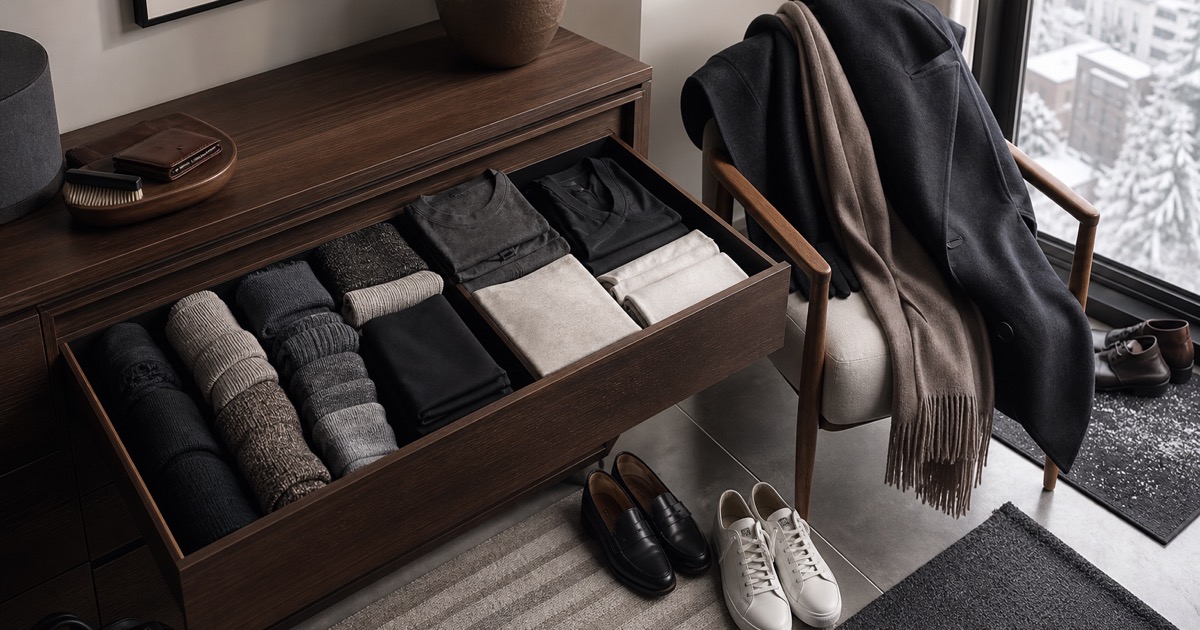
A cold commute outfit often fails in the quiet places. The coat may be right, the boots may be polished, and the bag may be packed, but a too-thick sock or a base layer that bunches under trousers can make the whole day feel improvised.
The better approach is a drawer system rather than a last-minute hunt. Socks, fitted leggings, underlayers, and shoe choices should be compared as one practical routine: what touches the foot, what sits under the clothes, what can be washed easily, and what still feels appropriate when the reader arrives indoors.
This guide keeps the decision practical. It does not treat base layers as a promise of warmth, performance, circulation, recovery, or comfort for every body. It compares formats, storage, shoe fit, laundry load, and the everyday question of whether a piece can be repeated without making the outfit harder to wear.
Quick Answer
Build the drawer around three jobs: one reliable crew sock for standard shoes, one lower-profile sock for loafers or indoor sneakers, and one fitted base layer only where the outer outfit has enough room. The right choice is the one that disappears into the outfit without disappearing from the laundry plan.
For office days, start with the shoe and trouser combination rather than the coldest possible scenario. A sock that feels sensible with winter boots may feel bulky inside a desk shoe, and a fitted layer that works under wide trousers may not sit well beneath a slim pair. The drawer should reflect the reader's real commute, not an imagined mountain morning.
Shop the Edit
Elite Fashion may earn a commission from qualifying purchases made through shopping links on this page. Links are chosen for editorial fit and practical relevance to the article topic.
Start With the Shoe Change
Many cold commute outfits involve two footwear moments: the outdoor pair and the pair worn inside. That shift decides whether crew socks or no-show socks make more sense. If the reader changes from boots into loafers, the sock has to work twice: once for the walk and once for the office.
Crew socks are useful when the cuff is part of the outfit or when the shoe has enough room. No-show socks are useful when the reader wants the shoe line to stay clean indoors. Neither is automatically better. The practical test is whether the sock creates rubbing, slipping, visible bunching, or a laundry burden that makes it hard to repeat.
Then Decide Whether a Base Layer Belongs
A base layer should solve a specific problem: cold transit platforms, a long walk from parking, a drafty office, or weekend errands where the reader does not want to change the whole outfit. If none of those moments appears often, the drawer may need better socks before it needs fitted leggings or a close-fitting shirt.
The cleanest base layer is the one that works with the outfit's shape. Waistbands should not stack awkwardly under trousers, necklines should stay hidden when the shirt is open, and sleeves should not pull under a blazer or knit. Compare each item by how it behaves under clothing, not by how technical it sounds.
Laundry Is Part of the Buying Decision
Cold-weather drawers fail when every useful piece is in the hamper by Wednesday. A reader who commutes five days a week may need more sock repetition than someone who works hybrid. A fitted layer also needs a washing rhythm that does not turn Monday's good idea into Friday's missing piece.
Before adding another product, count the actual weekly use. If crew socks carry three days and no-show socks carry two, that balance matters. If a fitted shirt is used only under one sweater, it may not deserve the same drawer space as a sock format that works with several shoes.
Keep the Office Arrival in Mind
The commute is only half the outfit. Once indoors, the reader may remove a coat, change shoes, sit in a warm meeting room, or walk to lunch. That means the best cold drawer supports transition. It should not create a bulky ankle, visible waistband, heavy neckline, or extra item that has nowhere to go.
Use neutral colors, repeatable textures, and a small number of reliable formats. A drawer with fewer categories but clearer jobs is easier to maintain than one filled with almost-right layers that each work with only one outfit.
How to Compare the Six Product Paths
Crew socks and no-show socks are the foundation because they decide whether shoes feel and look right. Fitted leggings, fitted pants, and close-fitting shirts are support pieces that should be added only when the outer outfit allows it. Performance socks belong in the comparison when the reader wants a sock built around movement or longer walking, but the decision should still be about fit, thickness, and care.
Read retailer pages for fabric, size range, pack count, care instructions, return terms, and current availability. This article is a shopping starting point, not a claim that any product will change health, circulation, injury risk, warmth, or physical performance.
Comparison Points
| Piece | What to compare |
|---|---|
| Crew socks | Best when the shoe has room, the cuff can show neatly, and the reader wants a repeatable everyday winter baseline. |
| No-show socks | Useful for indoor shoes, low sneakers, and loafers when the reader wants less visible sock at the office. |
| Fitted lower layers | Compare waistband, opacity, seam placement, and under-trouser bulk before choosing. |
| Fitted tops | Check neckline, sleeve behavior, and whether the top works beneath the shirts already in rotation. |
Use Cases
Transit-to-office day
Choose the sock around the indoor shoe first, then add a base layer only if the trouser shape can handle it.
Long walk plus desk day
Keep the sock practical and the layer smooth so the outfit still feels intentional after the coat comes off.
Weekend errands
Use the same drawer logic with denim, sneakers, and knitwear so cold-weather basics do not become a separate costume.
Before You Buy
Use retailer pages to confirm sizing, material, care instructions, pack count, color options, delivery timing, and return terms. The most useful purchase is the one that fits the real closet, not the one that creates a new problem to organize later.
Keep a short note after the first wear: what fit well, what needed tailoring or laundering, and what stayed unused. That small habit prevents duplicate purchases and makes the next shopping decision calmer.
Browse Category Hubs
Use these broader category hubs after the article-specific product options. Narrow by size, material, color, care needs, delivery options, and the storage space available at home.
FAQ
How many sock types should a cold commute drawer include?
Two clear sock roles are enough for many readers: one visible everyday sock and one lower-profile option for indoor shoes.
Should base layers be bought before socks?
Usually no. Socks affect every commute outfit, while base layers should be added only when a repeated cold-weather problem appears.
How can I avoid bulky winter office outfits?
Start with shoe fit, choose smoother sock textures, and test fitted layers under the actual trousers or knits they will be worn with.