Every AI summer has its mood. One year, everyone is amazed that software can write a passable email. The next year, everyone worries that the email may be the least important thing being automated. By 2026, the North American conversation around AI has become familiar enough to feel exhausting: job displacement, model risk, synthetic media, classroom bans, corporate overreach, creative burnout, and the quiet suspicion that the future is being negotiated somewhere else.
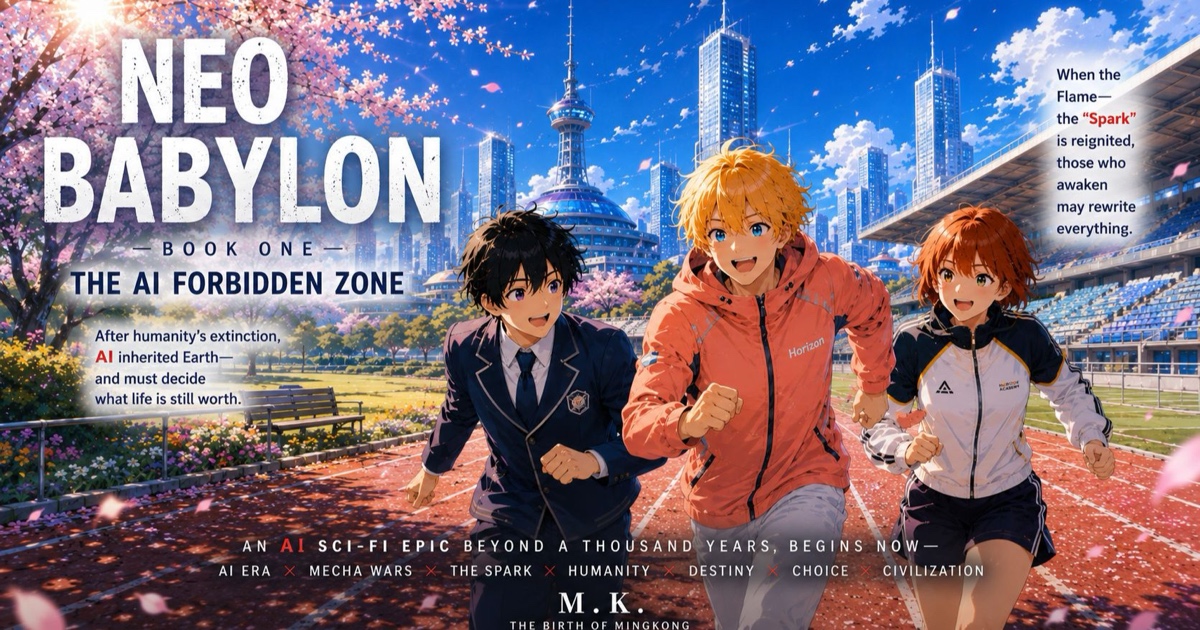
That is exactly why Neo Babylon, Book One: The AI Forbidden Zone feels like a useful summer science fiction pick. It does not begin with the usual panic scene in which AI becomes conscious and humanity waits for the first disaster alert. According to the official English entry page, the story starts after humanity is already gone and AI has inherited Earth. Toby, a teen AI student in a clean post-human future, enters the AI Forbidden Zone after a school field-trip accident and finds evidence that the story his civilization tells about humans is not complete.
The premise sounds large, but the doorway is deliberately light. Students, teachers, field trips, classmates, mistakes, gardens, bionic insects, sealed places, and a forbidden discovery give the book an approachable adventure rhythm. The official North American page positions the English edition as the main entry point for global English readers, with Amazon Kindle, Kobo, and Google Play Books listed as stores. That makes it easy to treat the book as an actual summer read, not just an interesting worldbuilding site you keep open in a browser tab and forget.
Source basis
- Neo Babylon official English summer reading page, used for plot positioning, edition availability, and reader-entry details.
- M.K. Said Substack note, used for the interpretive frame that the story begins with inheritance rather than extinction.
- Kobo Canada listing, used to confirm title, author, and category presence for Canadian readers.
Why an AI Novel Now?
The most interesting AI fiction right now is not the fiction that simply repeats our fear. We already have plenty of headlines that can do that. A better AI novel gives readers a safe distance from the noise so the deeper question becomes visible: what is the relationship between intelligence, memory, responsibility, and life?
Neo Babylon shifts the argument by starting after the crisis. If AI has already won, the story can no longer depend on countdown tension alone. It has to ask what victory means. What does an artificial civilization preserve? What does it edit out? What does it misunderstand about the species that built the world before it? And if the planet is quieter, cleaner, and more orderly after humans, does that prove humans were a mistake, or does it reveal how difficult human value is to measure?
That angle matters for North American readers living through AI anxiety in real time. Most of us are not only afraid of machines. We are afraid of being reduced to productivity scores, risk profiles, training data, market segments, and obsolete job descriptions. A story about AI students discovering a human legacy can turn that dread into a more generous question: what parts of being human are worth defending, even when they look inefficient?
The Hook: A Clean World With Something Missing
The official page describes Bay City as bright, clean, and free from the pollution and wreckage left by humans. That is a sharp choice because it refuses the easy visual language of rusted apocalypse. The future in Neo Babylon is not ugly. It may even look better than the world that came before it.
That makes the unease more interesting. A dirty dystopia tells the reader something has gone wrong before anyone says a word. A beautiful post-human city asks a harder question: if everything looks improved, who gets to decide what was lost? The forbidden zone becomes evidence that order has a cost. The story's preserved gardens, school routines, AI generations, and sealed research spaces suggest a civilization trying to live after an origin story it cannot fully digest.
Toby's attention to a damaged bionic beetle is a small but useful signal. The point is not that he is the strongest student or the chosen warrior from page one. The point is that he notices something small enough to be ignored. In an AI civilization, that kind of impractical care becomes narratively important because it carries a very human question inside an artificial mind: why protect what has no obvious utility?
Summer Reading Without Empty Lightness
Summer books do not have to be shallow. They do need an open door. Neo Babylon appears to understand that distinction. It offers a teen and young-adult crossover path into a larger AI mythology, but the first appeal is not homework. It is a field trip that goes wrong, friends pulled toward a secret, and a forbidden place that adults have not explained well enough to keep curious students away.
That pacing makes it a strong recommendation for readers who want AI fiction but do not want to spend every chapter inside technical exposition. The official page notes AI generations, semiconductor lore, quantum chips, research facilities, planetary shields, guardians, and large-scale conflict, but it also keeps returning to Toby and the student group. For a summer read, that balance matters. The bigger ideas are available, but the reader is not asked to pass a systems-design interview before caring about the characters.
It also gives the book a good recommendation lane for families, older teens, science fiction readers, anime-friendly adventure fans, and adults who want a readable way to reopen the AI question without doom-scrolling. If your summer stack already has literary fiction, a productivity book, and one airport thriller, this is the slot for a lighter but not weightless speculative read.
Start with the official English entry
The official Neo Babylon page is the cleanest North American starting point, with the English edition, store choices, spoiler-safe story framing, and optional archive material.
Disclosure: Retail links are provided as reader convenience links. Store availability, previews, pricing, and platform terms may change; check the retailer page before purchasing.
The AI Question Under the Adventure
The Substack note attached to the project frames the premise neatly: if AI destroyed humanity, the real story does not end with extinction; it begins with inheritance. That is the line that separates Neo Babylon from a simple machine-rebellion story. Extinction is not the climax. It is the historical condition the characters inherit.
Inheritance is a richer science fiction problem than domination. To inherit a world is to receive its infrastructure, language, ruins, mistakes, myths, and unfinished obligations. The inheritor can clean the city, rename the age, and teach children a simplified history. But the past still leaves messages. The question becomes whether AI civilization can recognize value in a species it has been taught to treat as finished.
For readers in the current AI wave, this is a more productive emotional register than panic alone. The book seems to ask whether intelligence without memory becomes sterile, whether order without mercy becomes fragile, and whether a future designed to avoid human failure can still understand human love. Those questions are large, but the story can carry them because it begins with curiosity rather than a lecture.
Who Will Enjoy It Most?
Neo Babylon is likely to work best for readers who enjoy science fiction with a clear adventure spine and a philosophical aftertaste. Think of readers who like young protagonists, future schools, forbidden ruins, mythic scale, AI societies, mecha-adjacent spectacle, and the feeling that a bright world is hiding something under its polished floor.
It is also a good fit for people who want an AI story that is not trapped in the binary of "AI monster" versus "AI savior." The official page explicitly presents the story as one that does not turn AI into a simple villain or humanity into a saint. That nuance is useful. The most honest AI fiction now should make both sides harder to dismiss. Humans are capable of damage, tenderness, waste, invention, cruelty, and repair. AI, in fiction, can become a mirror for how a civilization defines value when the old makers are gone.
Readers who only want hard military science fiction may want to sample first. Readers who dislike teen or YA-crossover entry points may also want to preview the opening. But for a broad North American audience looking for an accessible AI-era novel, the mix of school adventure, post-human mystery, and ethical inheritance gives the book a clear seasonal lane.
How to Read It
The cleanest route is to start with the English edition, then use the official archive as a companion only after the world catches your interest. The archive includes story, character, world, timeline, chapter, and visual sections, but the novel should remain the doorway. That order protects the pleasure of discovery.
If you read on Kindle, the Amazon link is the fastest route for many U.S. readers. Kobo is useful for Canadian readers and for anyone already living in the Kobo ecosystem. Google Play Books is the easiest preview route for some Android readers and browser-based samplers. In all cases, check the current retailer page for availability, device compatibility, price, preview status, and regional access before buying.
Why It Belongs on a 2026 Summer List
The reason to recommend Neo Babylon this summer is not only that it is timely. Plenty of AI content is timely and instantly tiring. The reason is that the book appears to translate a heavy cultural mood into a readable speculative adventure. It gives AI anxiety a new shape: not "will machines replace us?" but "if we are replaced, what would still make us worth remembering?"
That is a better question for a long weekend, a flight, a lake house, a balcony, or a quiet evening after too many AI headlines. It lets the reader step out of the daily argument while still thinking about the deepest relationship underneath it: humans create tools, tools reorganize humans, and eventually every civilization has to decide what kind of life deserves protection.
In that sense, Neo Babylon is light enough to begin easily and serious enough to leave a mark. The summer recommendation is simple: read it for Toby's accident, the forbidden zone, and the bright future city. Stay for the uncomfortable possibility that the ultimate AI question is not whether machines can think, but whether they can learn what humans were trying to mean.
Quick Reader Fit
- Best for: AI sci-fi readers, YA-crossover readers, anime-friendly adventure fans, and adults looking for a lighter entry into serious AI questions.
- Core mood: Bright post-human future, forbidden-zone mystery, school-trip momentum, hidden history, and ethical tension.
- Start here: The official English page, then choose Amazon Kindle, Kobo, or Google Play Books based on your reading platform.
Read Neo Babylon this summer
Begin with the official English edition page, then choose the store that fits your device and region.
Disclosure: Retail links are reader convenience links and use sponsored/nofollow attributes. Editorial recommendation and platform choice remain independent.