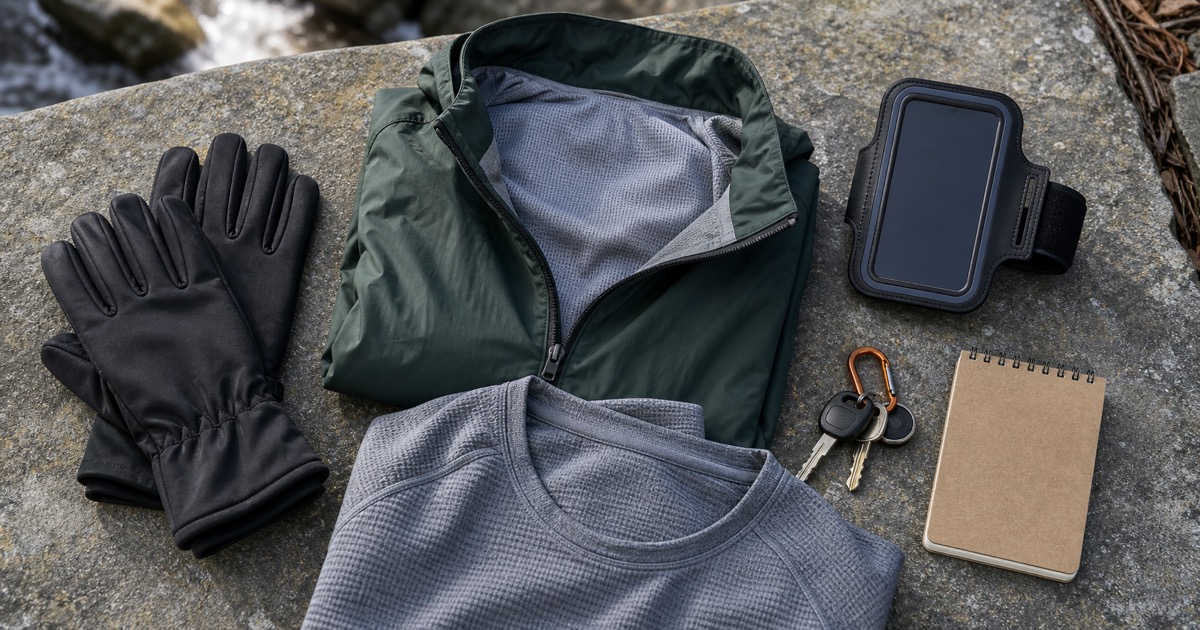
Cold trailhead and city-park movement days create a specific kind of dressing problem. The reader may not be heading into deep winter conditions, but the start of the route can still feel sharp. Hands get exposed while checking a map, a phone needs a secure place, and a light jacket has to move between walking, jogging, waiting, and coffee afterward. The mistake is buying the warmest-sounding item before understanding the route.
A calmer kit begins with route behavior. How long is the start-and-stop portion? Will the phone be checked often? Is the jacket worn the whole time or carried after a few minutes? Are gloves needed for waiting at the trailhead, walking a dog, or moving through a windy park? Those questions keep the purchase grounded in fit and sequence rather than dramatic outdoor language.
This guide avoids safety, warmth, traction, visibility, injury-prevention, or performance guarantees. It compares glove shape, sleeve interaction, pocket layout, phone access, packability, route timing, and manufacturer guidance. Readers should check weather, terrain, local advisories, product instructions, seller details, delivery timing, and return terms before buying.
Quick Answer
Build the kit around the route's first twenty minutes. Choose gloves for the coldest waiting or walking moment, phone carry for the amount of access the route needs, and a light run jacket for layer room, pockets, and packability. The best purchase is the one that supports the actual route without creating extra items to manage halfway through.
A cold movement kit should stay modest. Gloves, a phone holder or secure pocket plan, and one light jacket can cover many trailhead and city-park days when each piece has a clear job. Do not treat any product as a substitute for checking weather, route conditions, daylight, and manufacturer instructions.
Shop the Edit
Elite Fashion may earn a commission from qualifying purchases made through shopping links on this page. Links are chosen for editorial fit and practical relevance to the article topic.
Start With the Route, Not the Forecast App Alone
Forecasts help, but the route explains what the clothing has to do. A paved park loop, gravel trailhead, dog walk, short run, ferry-adjacent path, and wooded hill all create different stop-start patterns. The reader should decide where the coldest waiting moment occurs and where the body begins to warm up or shed layers.
That route map prevents overbuying. If the jacket will be tied around the waist after fifteen minutes, packability and pocket behavior matter more than a heavy-feeling shell. If the coldest part is waiting at the start, gloves may matter more than another top layer. The sequence tells the truth.
Compare Gloves by Cuff and Sleeve Interaction
Ski Gloves Men and Ski Gloves Women are useful glove search paths because they ask concrete questions: cuff length, closure, lining description, finger mobility, grip texture, care, and whether the gloves work with the jacket sleeves already owned. A glove that fights the sleeve can make an otherwise simple walk feel fussy.
Readers should avoid treating a product title as a promise about conditions. Instead, compare the listing, current materials, intended use language, and return terms. If the route is technical, remote, icy, or exposed, broader planning and appropriate guidance matter more than a single accessory purchase.
Decide Whether the Phone Needs Arm Carry
Armband Phone Holder is a phone-carry search path, not a universal answer. Some routes are better served by a jacket pocket, waist belt, vest pocket, or secure bag. Arm carry becomes useful when the reader wants frequent screen access and the band works with sleeve layers without sliding, twisting, or blocking movement.
Compare band size, closure, screen access, phone case fit, cable or earbud needs, and whether the route includes enough starts and stops to justify the holder. If the phone will be checked only once, a secure pocket may be simpler. If the route involves music, maps, or interval timing, the carry method deserves more attention.
Use Light Jackets as Route Tools
Running Jacket Men and Running Jacket Women can be compared by shell weight, zipper behavior, pocket placement, sleeve shape, layer room, and packability. A light jacket should support the route without becoming a second problem to carry, tie, or stuff into a small bag.
Layer room matters because gloves, phone holders, and base pieces interact. A tight sleeve may fight an armband. A pocket may bounce with a phone. A zipper may be awkward with gloves. The reader should imagine the actual hand movements: checking a map, opening a gate, adjusting a cuff, reaching for keys, or grabbing coffee afterward.
Keep Safety Planning Separate From Shopping
Shopping can make a route feel planned before it actually is. The practical kit is only one part of preparation. Readers should check current weather, daylight, route conditions, local advisories, and manufacturer instructions. For unfamiliar terrain or winter conditions, they should choose conservative routes and appropriate guidance.
This distinction protects the buying decision from exaggerated claims. Gloves, phone holders, and jackets can help organize a movement day, but they do not guarantee safety, warmth, visibility, traction, or injury prevention. The right comparison stays honest about what a product can and cannot decide.
Build the Small Movement Kit
A compact kit can live near the door: gloves, jacket, phone-carry choice, keys, and any route-specific basics. Keep the items together so the reader does not buy duplicates after misplacing the first pair of gloves or leaving a holder in another bag. A small hook, bin, or pouch can do more for consistency than another accessory.
After the route, reset the kit immediately. Dry or air items as directed, return the phone holder to the same place, and note whether the jacket was worn, carried, or never needed. That review guides the next purchase with real evidence from the reader's own route.
A Buying Sequence for Colder Movement Days
First, name the route and the coldest waiting point. Second, decide whether hands, phone access, or layer carry is the main friction. Third, compare size, material notes, closure, pocket layout, care, seller details, delivery timing, and return terms. Fourth, check the kit against what is already near the door. Fifth, update the kit after the first use.
The goal is not to build a dramatic outdoor wardrobe. It is to make colder, ordinary movement days easier to start and easier to reset.
Comparison Points
| Piece | What to compare |
|---|---|
| Gloves | Compare cuff length, closure, lining notes, finger mobility, care, and whether they work with existing jacket sleeves. |
| Phone holder | Check band size, screen access, closure, phone-case fit, sleeve interaction, and whether the route needs frequent access. |
| Light jacket | Compare shell weight, zipper behavior, pocket layout, sleeve shape, layer room, and packability. |
| Route reset | Keep items together near the door, dry or air them as directed, and note what was actually used. |
Use Cases
City-park run walk
Use a light jacket with workable pockets, gloves for the waiting moment, and phone carry only if screen access matters.
Trailhead dog walk
Prioritize gloves and simple pocket access, then choose a jacket that handles stop-start movement without extra fuss.
Coffee-after loop
Choose pieces that can move from path to public stop without needing a full change or a loose pile of carried layers.
Before You Buy
Use retailer pages to confirm sizing, material, care instructions, pack count, color options, delivery timing, and return terms. The most useful purchase is the one that fits the real closet, not the one that creates a new problem to organize later.
Keep a short note after the first wear: what fit well, what needed tailoring or laundering, and what stayed unused. That small habit prevents duplicate purchases and makes the next shopping decision calmer.
Browse Category Hubs
Use these broader category hubs after the article-specific product options. Narrow by size, material, color, care needs, delivery options, and the storage space available at home.
FAQ
What should I buy first for colder trailhead days?
Start with the repeated friction: cold hands, phone access, or a jacket that is hard to carry after the route begins.
Is an armband phone holder always better than a pocket?
No. It is useful when frequent access matters and the band works with sleeves; a secure pocket may be simpler for many routes.
Can this guide tell me what is safe for winter routes?
No. It compares shopping fit. Readers should check weather, route conditions, daylight, local advisories, and manufacturer guidance.