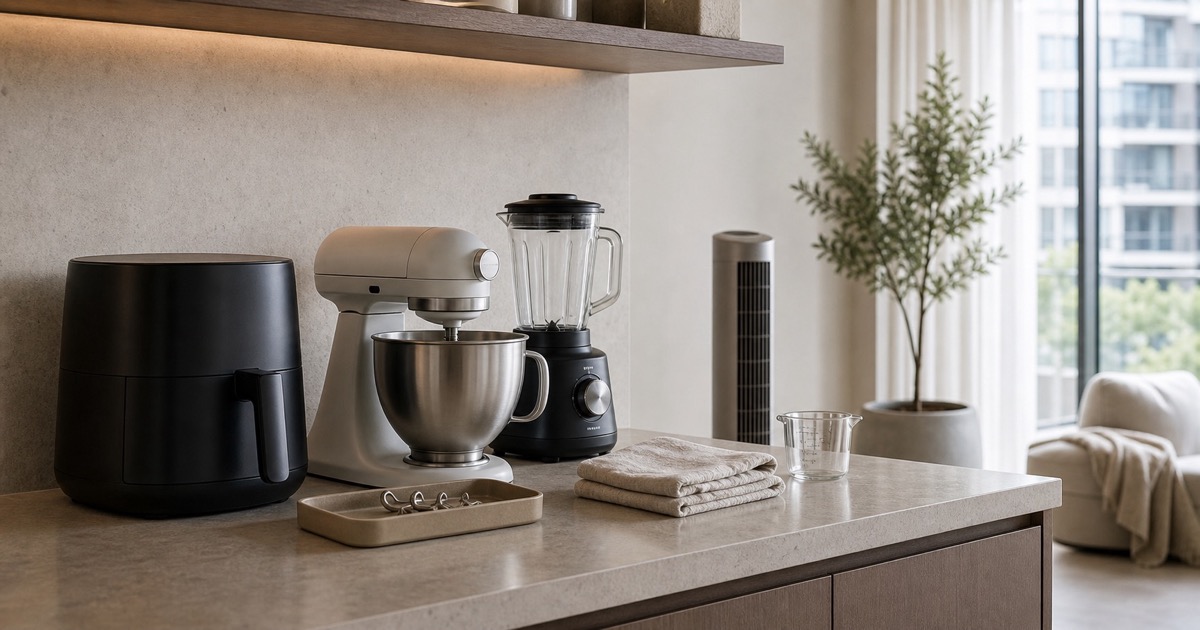
A secondary appliance can make a small apartment feel capable or crowded. The same counter may need to hold prep work, coffee, groceries, a dish rack, mail, and one or two machines that promise to help the week. When every machine claims a permanent place, the counter stops acting like a workspace.
The stronger approach is to make each appliance defend its footprint. An air fryer, stand mixer, blender, or tower fan can be useful in the right routine, but usefulness depends on frequency, storage, cleaning, cord path, cabinet height, and whether the object can be moved without disrupting the room. Even a tiny support piece such as shower curtain hooks should have a clear job before it enters the cart.
This guide compares footprint, storage path, access, cleaning rhythm, counter permanence, and routine value. It does not promise cooking results, energy savings, safety outcomes, appliance performance, or durability. Readers should confirm dimensions, manufacturer guidance, seller information, return terms, and current availability on retailer pages before buying.
Quick Answer
Give permanent counter space only to the appliance used often enough that storing it away would create more friction than leaving it out. Everything else should have a cabinet, shelf, pantry, or seasonal storage path before purchase. The best secondary appliance is the one that fits the room and the week, not the one that looks impressive in a product photo.
For many small apartments, the hierarchy is simple: one daily beverage or prep station, one secondary cooking or baking appliance, and one clearly contained support drawer. If the counter already feels full, compare storage first. A machine that has nowhere to go will slowly turn into a surface tax, even if the idea behind it is appealing.
Shop the Edit
Elite Fashion may earn a commission from qualifying purchases made through shopping links on this page. Links are chosen for editorial fit and practical relevance to the article topic.
Map the Counter Before Comparing Machines
Start by dividing the counter into zones: prep, hot items, sink support, coffee or breakfast, and landing space. A secondary appliance should fit one of those zones without stealing the only clear surface. If it needs to move every time vegetables are chopped or groceries are unpacked, it may belong in a cabinet rather than in the front row.
Measure height under cabinets, depth near outlets, and the path from storage to use. A blender jar or stand mixer head can be taller than expected. An air fryer basket needs pull-out clearance. A tower fan needs a cord path and floor space. The measurement step is not glamorous, but it prevents the most common apartment counter regret.
Air Fryers Need Access, Not Drama
Philips Air Fryer is a useful search path for comparing footprint, basket access, handle clearance, cleaning path, and where the appliance rests between uses. The question is not whether an air fryer can be helpful in general. The question is whether the reader has a repeated meal pattern and a counter or cabinet route that makes use realistic.
If it lives on the counter, it should not block the main prep zone. If it lives in a cabinet, it should be reachable without a full rearrangement. The most practical choice is the one the reader can use, clean, and return without making the kitchen feel interrupted.
Stand Mixers Should Match Baking Frequency
KitchenAid Artisan Mixer is a stand mixer search path for comparing counter permanence, bowl storage, attachment storage, cabinet height, and whether the reader bakes often enough to justify the visible footprint. A stand mixer can be beautiful, but beauty alone is a weak reason to surrender a small counter.
For occasional bakers, a lower shelf, appliance garage, or dedicated baking cabinet may be better than permanent display. For frequent bakers, leaving the mixer out can make sense if flour, bowls, measuring tools, and cooling space are nearby. The machine should be part of a baking route, not an isolated object.
Blenders Work Best With a Cleaning Plan
Blendtec Blender is a useful route for comparing jar height, lid storage, base footprint, cord behavior, and whether the blender is used for breakfast, sauces, soups, or occasional entertaining. A blender often fails the counter test when cleanup and drying space are ignored.
Before buying, decide where the jar dries, where the lid lives, and whether the base stays out or returns to a cabinet. If the blender requires moving three things before and after every use, it may not belong in a small kitchen front row.
Do Not Forget Non-Kitchen Objects
Tower Fan may seem outside the appliance-counter conversation, but in apartments it often competes for the same storage logic: where does it stand, where does the cord run, and where does it go during cooler months? Compare footprint, seasonal storage, and whether the fan belongs near the kitchen, living area, or bedroom rather than drifting between rooms.
The goal is not to make every object permanent. It is to decide which objects deserve quick access. A fan without a seasonal storage plan can create the same visual clutter as a rarely used kitchen appliance.
Small Support Pieces Still Need a Reason
Shower Curtain Hooks is a small support search path, but it belongs in the edit because little items often multiply without a plan. Hooks can solve towel, curtain, cabinet, or utility storage friction, but only when count, finish, location, and task are clear before purchase.
Use support pieces to reduce friction, not to decorate around unresolved clutter. If a hook or tray gives an appliance cord, towel, or attachment a stable home, it can be valuable. If it simply creates another category to organize, leave it out.
Build the Counter Hierarchy
First, keep the daily station clear. Second, choose one secondary appliance that matches a repeated weekly routine. Third, assign every occasional appliance a cabinet, shelf, or seasonal home. Fourth, use small support pieces only where they remove a specific storage problem.
This hierarchy protects the counter from becoming a showroom. A small kitchen works better when the reader can prepare food, set down groceries, and clean up without negotiating with every object in the room.
Comparison Points
| Format | What to compare |
|---|---|
| Air fryer | Compare footprint, basket access, cleaning route, outlet position, and whether it belongs out or stored. |
| Stand mixer | Best for frequent baking when bowl, attachment, flour, and cooling-space storage are planned together. |
| Blender | Check jar height, lid storage, drying space, base footprint, and whether use frequency justifies access. |
| Tower fan and hooks | Compare seasonal storage, cord path, count, finish, and whether the support piece solves a real storage issue. |
Use Cases
Small apartment kitchen
Keep one daily station clear and let only one secondary appliance live out full time.
Weekend baking routine
Group mixer, bowl, attachments, measuring tools, and storage before giving the mixer counter space.
Open-plan living area
Treat fans, hooks, and appliance cords as visible objects that need a calm storage path.
Before You Buy
Use retailer pages to confirm size, dimensions, seller information, material or manufacturer details, care or cleaning guidance, delivery timing, and return terms. This article compares shopping fit, storage behavior, and routine role; it is not technical, medical, safety, or performance advice.
When the new item arrives, remove one duplicate, rarely used, or poorly fitting item from the same drawer, shelf, closet, or counter zone. That small reset keeps the purchase from becoming another object to manage.
Browse Category Hubs
Use these broader category hubs after the article-specific product options. Narrow by size, seller details, material or manufacturer preferences, delivery options, and the amount of space available at home or in a bag.
FAQ
How many secondary appliances should stay on a small counter?
One secondary appliance is enough for many small kitchens once a daily coffee or prep station is already present.
Should a stand mixer live on the counter?
Only if baking frequency, cabinet height, bowl storage, and prep space make permanent access more useful than storage.
What should I check before buying?
Confirm dimensions, seller details, manufacturer guidance, return terms, cord placement, cleaning needs, and where the item will live.