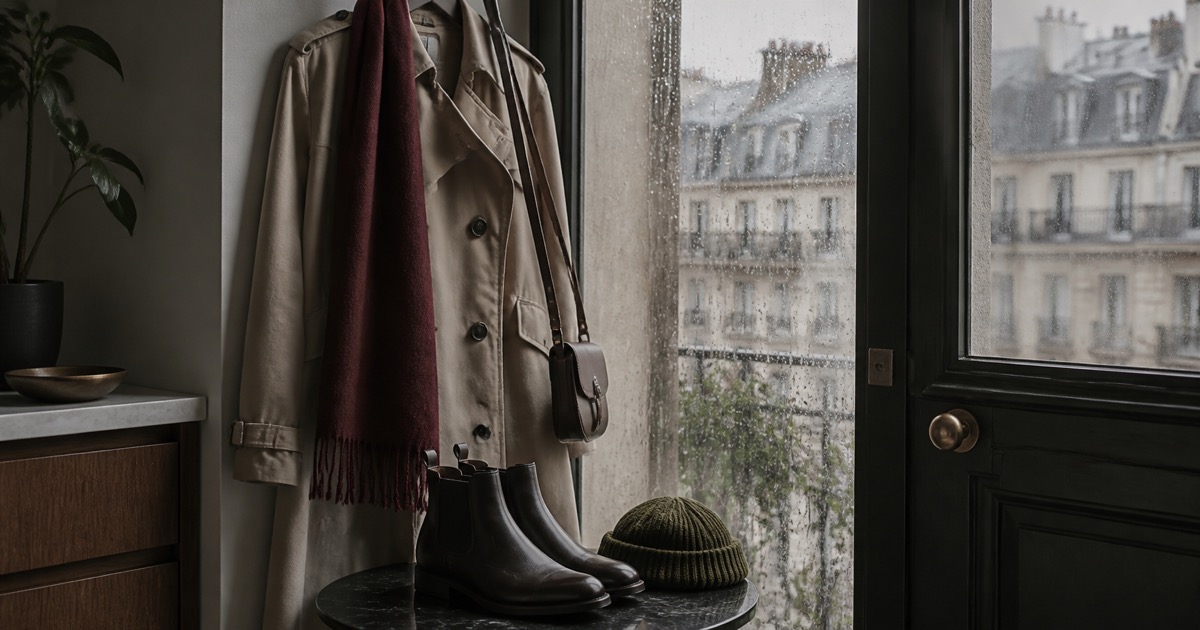
A rainy city day asks for a different kind of polish than a dry fall morning. The outfit has to move through sidewalks, transit, elevators, office lobbies, coffee counters, school runs, and quick errands while still feeling like a considered look. The mistake is treating every item as if it needs to be serious outdoor equipment. Most urban days need a balanced layer system, not a head-to-toe storm uniform.
The trench coat, scarf, Chelsea boots, crossbody bag, and beanie each solve a different styling problem. The coat creates the line. The scarf softens the face and fills the neckline. The boots ground the outfit. The bag keeps the hands free. The beanie is optional, but useful when the outfit needs a practical finish that does not fight the rest of the look.
This guide does not make waterproofing, warmth, slip-resistance, leather-authenticity, or all-day comfort claims. Product pages should be checked for materials, care instructions, dimensions, return terms, and current availability. The goal is a practical comparison of styling role, proportion, maintenance, and commute fit.
Quick Answer
Start with a trench coat that fits over the actual layers you wear, then choose a scarf that can either tuck inside the collar or sit loosely over it. Pair the coat with Chelsea boots only if the shaft height and toe shape work with the trousers, jeans, or skirt in rotation. Add a leather crossbody bag when hand-free movement matters, and use a merino beanie as a finishing piece when the outfit needs softness at the top.
The easiest rainy-city formula is not the most technical one: knee-length or mid-thigh coat, quiet scarf, simple ankle boot, compact crossbody, and one knit accessory. Keep the palette controlled so wet-weather pieces still look intentional indoors. Camel, black, charcoal, olive, cream, and deep red can mix well without becoming costume-like.
Shop the Edit
Elite Fashion may earn a commission from qualifying purchases made through shopping links on this page. Links are chosen for editorial fit and practical relevance to the article topic.
Build the Line With the Trench
A trench coat earns its place when it gives the outfit structure before any accessories are added. Compare length first. A shorter trench can feel easier with jeans and a crossbody bag, while a longer coat can make a commute outfit look calmer and more dressed. The best length depends on height, preferred trousers, and whether the reader needs to sit on transit without extra fabric bunching awkwardly.
Closure, belt behavior, shoulder shape, lining, and care guidance matter more than a dramatic product name. A coat that looks elegant online can feel fussy if the belt slips, the collar collapses, or the sleeve does not allow a cardigan underneath. Before buying, imagine the coat worn open, buttoned, belted, and carried over the arm inside a warm room.
Use the Scarf to Control Volume
The scarf decides whether the top half of the outfit feels finished or crowded. Compare length, width, fabric feel, fringe, and color. A narrow scarf can tuck cleanly inside a trench collar, while a larger wrap can create softness over a simple knit. Both can work, but they create very different amounts of volume around the neck and bag strap.
Color should support the coat rather than compete with wet sidewalks and umbrella clutter. A burgundy, olive, gray, navy, or soft cream scarf can give the outfit life without making the rain-day look feel loud. If the trench is already textured or patterned, a quieter scarf often gives the better result.
Choose Boots by Proportion, Not Drama
Chelsea boots are useful because they sit between polished and practical, but the details change the tone quickly. Compare toe shape, shaft height, elastic panels, heel profile, sole thickness, and care instructions. A sharper toe can dress up straight trousers; a rounder toe can work with denim; a heavier sole can shift the whole outfit toward a more casual mood.
Avoid treating a listing as a promise about grip, weather protection, or long-wear comfort. Fit, surface conditions, socks, and maintenance all matter. The safer comparison is visual and practical: does the boot work with the hem, can it be cared for realistically, and does it still look appropriate when the coat comes off indoors?
Let the Crossbody Bag Keep the Day Moving
A leather crossbody bag is strongest on rainy days because it keeps the hands free for doors, umbrellas, transit cards, and grocery bags. Compare strap drop, adjustability, closure, hardware tone, interior pockets, and whether the bag sits comfortably under or over the trench. A bag that constantly catches the belt or scarf will make the outfit feel busier than it looks.
Capacity should be judged honestly. Phone, wallet, keys, lip balm, transit card, sunglasses, and a small pouch may be enough for some readers. A laptop, water bottle, and lunch need a different bag plan. The crossbody is most useful when it supports a focused city day rather than pretending to replace every carry option.
Add a Beanie Only When It Clarifies the Outfit
A merino beanie can make a rainy or windy fall outfit feel warmer in mood, but it should not be automatic. Compare cuff height, knit density, fiber notes, and how the color works with the scarf. If the beanie and scarf are both bulky, the top half can overpower the clean line of the trench.
The best version looks deliberate when removed as well as worn. A beanie that folds into the crossbody bag, coat pocket, or work tote without creating lint or bulk will be easier to repeat. If hair volume, office setting, or a dinner plan makes the beanie feel wrong, a scarf alone may be the cleaner finish.
Plan Three Rainy-Day Formulas
For a work commute, pair a mid-length trench with a narrow scarf, slim crossbody, straight trousers, and clean Chelsea boots. For an errand day, use a softer scarf, denim, a roomier crossbody, and a beanie if the outfit needs a casual top note. For a dinner-after-work version, keep the scarf tonal, choose a more refined boot shape, and let the coat stay open when indoors.
Each formula should be tested against the moments that usually make rainy dressing messy: carrying an umbrella, removing a layer in a cafe, sitting on transit, stepping into a warmer room, and storing the scarf or hat. If the outfit only works in a still photo, it is not a useful city uniform.
Care and Storage Matter
Rainy pieces need a landing routine. The coat needs a hanger with enough shoulder support, the scarf needs a place to dry or air out according to care guidance, boots need whatever cleaning routine the material requires, and the crossbody bag should not be dropped on a damp floor. A small weekly reset makes the outfit easier to repeat.
Before buying, check retailer pages for dimensions, materials, lining, care instructions, color accuracy, and return terms. The best rainy-day purchase is the piece that fits the existing wardrobe and can be maintained without adding another complicated chore.
Comparison Points
| Piece | What to compare |
|---|---|
| Trench coat | Compare length, shoulder shape, belt behavior, lining, sleeve room, and care instructions. |
| Scarf | Compare length, width, fiber notes, drape, color, fringe, and how it sits with the coat collar. |
| Chelsea boots | Compare shaft height, toe shape, sole profile, heel height, care guidance, and hem compatibility. |
| Leather crossbody bag | Compare strap drop, closure, pocket layout, hardware tone, capacity, and how it works with coat volume. |
| Merino beanie | Compare cuff shape, knit density, color, storage ease, and whether it suits the scarf without crowding the face. |
Use Cases
Office commute
Use the trench for structure, a narrow scarf for polish, and a crossbody that does not compete with the coat belt.
Weekend errands
Let denim, Chelsea boots, a softer scarf, and a beanie make the outfit practical without looking accidental.
Dinner after rain
Choose a quieter scarf and cleaner boot shape so the coat can come off and the outfit still feels complete.
Before You Buy
Use retailer pages to confirm sizing, dimensions, materials, care instructions, color options, delivery timing, and return terms. The best choice is the one that fits the real routine and the real storage space, not the one that looks most complete in isolation.
After the first week of use, notice what was reached for, what stayed in the drawer, and what made cleanup harder. That small review is often more useful than adding another product before the routine has proved itself.
Browse Category Hubs
Use these broader category hubs after the article-specific product options. Narrow by size, material, format, care needs, delivery options, and the space available at home or work.
FAQ
What should I wear on a rainy city day?
Start with a structured coat, add a scarf that controls neckline volume, choose boots that work with the hem, and keep the bag compact enough for hands-free movement.
Are Chelsea boots a good choice for wet fall commutes?
They can be a useful city style option, but readers should check material, care guidance, fit, and surface conditions rather than assuming weather or grip performance.
How do I keep rainy outfits polished?
Use a controlled color palette, avoid too much bulk around the neck, and give each piece a clear storage and care routine after wearing.