Transitional outerwear is the part of a wardrobe that gets judged in motion. It has to leave the apartment cleanly, sit under a tote strap, handle a commute, work with a quick errand, and come off easily once the reader reaches a warmer room. The challenge is not owning every jacket type. It is knowing which layer has a real job on the days between clear seasons.
For many readers, the most useful system has three roles: a polished layer that makes casual clothes feel intentional, a soft insulated layer for colder starts, and a vest or lighter option that can be added without changing the whole outfit. The right balance depends on how often the reader walks, drives, uses transit, carries luggage, or moves between indoor and outdoor spaces.
This guide compares outfit role, storage behavior, collar shape, pockets, layering room, packing volume, and weather-check habits. It does not promise warmth, waterproofing, fabric durability, or protection in severe conditions. Readers should confirm size charts, material details, care instructions, seller information, return terms, and current availability on retailer pages before buying.
Quick Answer
Choose transitional outerwear by the day pattern first. Errands usually need easy pockets and quick on-off movement. Commutes need a clean shoulder line and enough room for a bag strap. Travel days need a layer that can be carried, packed, or worn through changing indoor temperatures without becoming the most difficult item in the outfit.
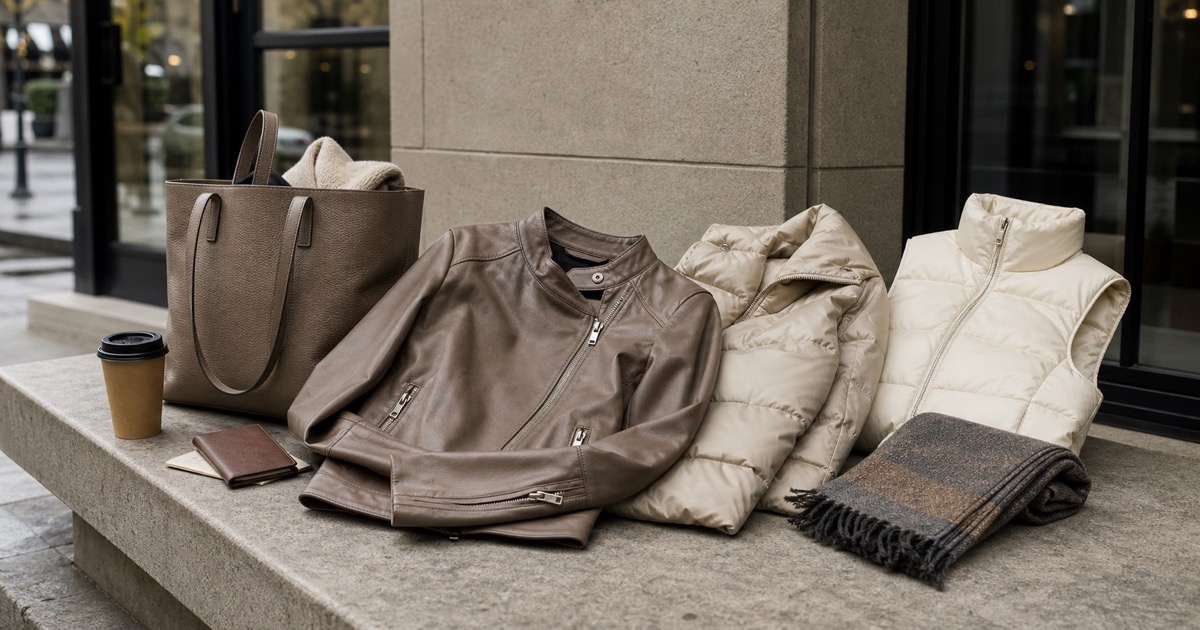
A leather jacket can act as the polished layer, a puffer can handle casual cold starts, and a down vest can bridge the gap when sleeves would feel like too much. The smartest buy is the missing role, not the most dramatic jacket. If the closet already has two polished jackets, the next improvement may be a vest or lighter insulated layer that changes how the week functions.
Shop the Edit
Elite Fashion may earn a commission from qualifying purchases made through shopping links on this page. Links are chosen for editorial fit and practical relevance to the article topic.
Start With the Day Pattern
Before comparing products, name the actual route. A reader who walks to coffee, stops at a post office, and works from a laptop bag needs different outerwear than someone driving to a client meeting or packing for a two-night train trip. The route reveals whether pockets, packability, collar height, or shoulder comfort should lead the decision.
The most common mistake is buying for the coldest imagined moment and then feeling overdressed for the rest of the day. Transitional dressing is about adjustment. A layer should be easy to open, carry, or combine with knitwear. If the jacket only works in one exact temperature or with one exact outfit, it may be too narrow for the role.
Use a Leather Jacket as the Polished Layer
Leather Jacket Men and Leather Jacket Women are useful starting paths when the outfit needs a sharper edge without becoming formal. Compare length, shoulder room, sleeve behavior, zipper placement, and whether the jacket works over a tee, knit, or button-down. A polished layer earns space when it improves simple outfits repeatedly.
This role is especially useful for errands that turn into lunch, office-adjacent commutes, and travel days where the reader wants to look put together after arrival. The jacket should not fight the bag. Check whether a tote, backpack, or crossbody strap sits cleanly over the shoulder and whether the pockets can hold small items without distorting the front.
Let Puffers Handle Casual Cold Starts
Puffer Jacket is a practical search path for readers comparing casual bulk, zipper behavior, hood needs, storage, and whether the jacket works with denim, joggers, trousers, or travel clothes. A puffer can be useful when the day begins cold but does not require a fully dressy coat.
The comparison should stay grounded. Look at how the jacket sits in an entryway, whether it can be worn while carrying a bag, and whether it becomes too much once indoors. The best puffer for this role is not necessarily the thickest; it is the one the reader can repeat without reorganizing the entire outfit around it.
Use Vests When Sleeves Are the Problem
Down Vest Men and Down Vest Women belong in the decision when the reader wants the torso layer without sleeve bulk. A vest can work over knits, under certain coats, or on mild errand days when a full jacket feels heavy. Compare collar height, arm opening, length, pocket placement, and whether it layers without crowding the shoulder.
Vests are also useful for travel days because they can be easier to carry than a full jacket. They should still have a defined place. If a vest is only worn once because it does not match the trousers, bag, or knitwear already in use, it becomes a storage problem rather than a transitional solution.
Keep Travel Days Practical
Down Jacket Women is a helpful route for comparing pack volume, pocket behavior, closure, and whether the jacket works for a colder travel day. The question is not whether the layer can solve every condition. The question is whether it supports the known itinerary: station, car, airport, hotel lobby, museum, dinner, or a short walk with luggage.
For travel, test the layer with the bag before leaving. A jacket that looks good at home may bunch under a backpack or make a crossbody strap slide. Check how easily it can be removed, carried over an arm, or folded into luggage if the afternoon turns warmer.
Build a Small Outerwear Rotation
One polished jacket, one casual insulated layer, and one lighter bridge layer can cover many transitional weeks. The exact categories can change, but the roles should remain clear. A closet with six versions of the same black jacket is less useful than three different layers that answer different days.
After buying, remove or downgrade one outerwear piece that no longer has a role. That small reset keeps the entryway and closet readable. Transitional dressing works best when the reader can see the options quickly and choose by the day ahead rather than by a crowded rack.
Comparison Points
| Format | What to compare |
|---|---|
| Polished jacket | Compare length, shoulder room, closure, pockets, bag-strap behavior, and whether it sharpens casual outfits. |
| Puffer jacket | Compare bulk, zipper behavior, hood needs, storage, and whether it is easy to remove indoors. |
| Down vest | Useful when the reader wants a bridge layer with arm freedom and less packing volume. |
| Travel layer | Check carry behavior, pocket use, foldability, and whether it works with luggage and the day plan. |
Use Cases
Errand chain
Choose pockets and easy on-off movement so the jacket supports short stops without becoming fussy.
Office commute
Prioritize shoulder line, bag-strap comfort, and a layer that still looks clean after sitting.
Short travel day
Compare packability, carrying comfort, and whether the layer works from station to hotel to dinner.
Before You Buy
Use retailer pages to confirm size, dimensions, seller information, material or manufacturer details, care or cleaning guidance, delivery timing, and return terms. This article compares shopping fit, storage behavior, and routine role; it is not technical, medical, safety, or performance advice.
When the new item arrives, remove one duplicate, rarely used, or poorly fitting item from the same drawer, shelf, closet, or counter zone. That small reset keeps the purchase from becoming another object to manage.
Browse Category Hubs
Use these broader category hubs after the article-specific product options. Narrow by size, seller details, material or manufacturer preferences, delivery options, and the amount of space available at home or in a bag.
FAQ
How many transitional outerwear pieces are enough?
Three clear roles are enough for many readers: a polished layer, a casual insulated layer, and a lighter bridge layer.
Should I buy a vest or another jacket?
Choose a vest when sleeve bulk is the repeated issue; choose a jacket when the closet lacks a complete outer layer.
What should I check before buying?
Confirm size charts, material details, care instructions, seller information, return terms, and whether the layer fits the real route.