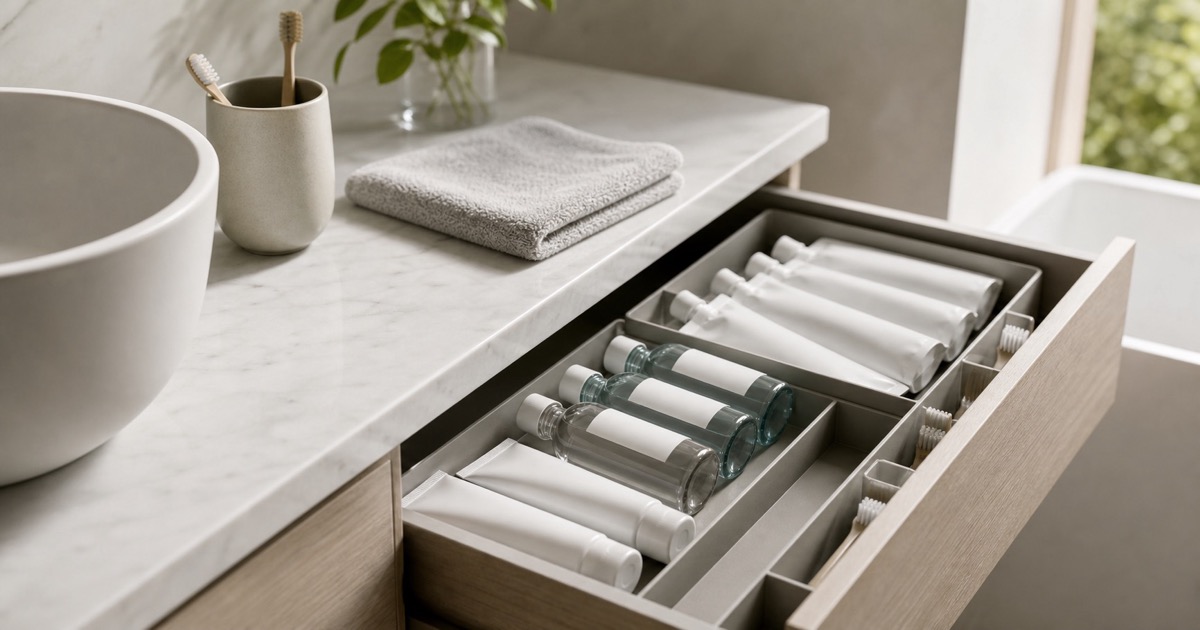
Oral care shopping can become strangely loud for something that lives in a small bathroom drawer. Product pages may talk about whitening, breath, sensitivity, enamel, clinical language, flavor, pack count, travel size, and family value before the reader has answered the most useful question: where will this actually live?
A calmer refill drawer starts with ordinary household behavior. Toothpaste tubes should be easy to find before the current tube is empty. Mouthwash bottles should fit the cabinet or drawer without crowding the sink. Travel backups should stay with the toiletry pouch rather than drifting into the daily drawer. The goal is not a dramatic routine; it is a drawer that makes everyday replenishment easier.
This guide deliberately avoids dental, whitening, sensitivity, breath, enamel, or clinical outcome claims. Readers should confirm current labels, directions, ingredients, seller details, package size, delivery timing, and return terms on retailer pages and product packaging. Personal oral health questions belong with a qualified dental professional.
Quick Answer
Build the drawer around one open toothpaste, one backup toothpaste, one mouthwash only if it is genuinely used, and a small travel zone that does not steal space from daily basics. A refill drawer should answer three questions quickly: what is open, what replaces it, and what is packed for trips.
The best choice is usually the format that fits the room and the household, not the product page with the boldest language. Compare tube caps, bottle height, flavor descriptions, package count, seller details, label directions, and where each item will sit. If a bottle is too tall for the cabinet or a multipack has no storage home, it is not a low-clutter purchase.
Shop the Edit
Elite Fashion may earn a commission from qualifying purchases made through shopping links on this page. Links are chosen for editorial fit and practical relevance to the article topic.
Start With the Refill Rule
A refill drawer works when it prevents both emergencies and overbuying. Keep one active tube near the sink and one backup in a known place. When the active tube moves toward empty, the backup becomes the next tube and the shopping list gets one replacement. That simple rhythm is easier than guessing how many tubes are somewhere under the sink.
This rule also prevents a drawer full of half-used variations. If the household rotates between Colgate Toothpaste, Crest Toothpaste, or another familiar tube, write the role clearly: daily tube, backup tube, travel tube, or guest tube. A product without a role becomes clutter even when it is useful in theory.
Treat Mouthwash as a Bottle Decision
Mouthwash is often a storage question before it is a brand question. Listerine Mouthwash and TheraBreath Mouthwash are both bottle-format search paths, so compare height, cap control, weight, flavor notes, pour behavior, and whether the bottle belongs on the counter, inside a cabinet, or in a lower drawer. A large bottle can be economical but awkward if it has to be lifted around a crowded sink every night.
For shared bathrooms, decide whether mouthwash is shared or personal. A shared bottle needs a visible spot, clear closure, and enough room to stand upright. Personal bottles may belong in separate bins. Either way, the drawer should reduce confusion rather than line up several bottles that compete for the same moment.
Read Labels Without Turning Them Into Promises
Labels matter because they show ingredients, directions, warnings, flavor language, age guidance, and storage details. They should be treated as current information, not as a promise that a product will create a specific result for every reader. Formulas, sellers, and pack sizes can change, so the retailer page and the package itself should both be checked.
This is especially important for readers comparing products around sensitivity language or personal preferences. Sensodyne Toothpaste can be approached as a label-reading search path: check directions, ingredients, package count, seller information, and professional guidance needs before buying. The shopping decision should remain grounded in fit and clarity, not unsupported assumptions.
Keep Travel Refills Separate
Travel backups should not disappear into the daily drawer. A small tube, floss, toothbrush cover, or compact mouthwash format belongs with the toiletry pouch or travel bin. When travel items live beside daily refills, they tend to get used at home and then go missing before a trip.
A separate travel zone also helps readers avoid buying duplicates before every weekend away. After a trip, reset the pouch immediately: replace the empty tube, dry the toothbrush cover, check caps, and put the pouch back in the same place. The system is simple, but it saves the rushed late-night search.
Make the Drawer Easy to Share
Shared oral care drawers should avoid mystery piles. Use one small tray for active daily pieces, one labeled-feeling zone for sealed backups, and one lower-priority area for guests or travel. Even without labels, the layout should make the job obvious from placement.
Avoid letting multipacks take over the most accessible space. Extra tubes can live farther back because they are not touched daily. The front row should serve the current routine: open tube, brush cup, floss if used, and any bottle that has a real role. Everything else should support replenishment quietly.
A Buying Sequence for a Calm Drawer
First, check what is already open. Second, decide whether the household needs toothpaste, mouthwash, travel stock, or guest stock. Third, compare package size, cap style, bottle height, label directions, seller details, delivery timing, and return terms. Fourth, remove expired, disliked, or duplicated items before adding the new pack.
That final reset is what keeps refills from becoming a storage problem. A small drawer can serve a whole household well when each item has a job and every replacement has somewhere to go.
Comparison Points
| Format | What to compare |
|---|---|
| Toothpaste tube | Compare cap style, tube count, package size, seller details, directions, and whether it is daily, backup, guest, or travel stock. |
| Mouthwash bottle | Check bottle height, cap behavior, flavor notes, storage position, pour control, and whether it is shared or personal. |
| Travel refill | Keep small-format basics with the toiletry pouch so they are not used up before the next trip. |
| Shared drawer zone | Separate active pieces from sealed backups so the drawer can be reset quickly after busy mornings. |
Use Cases
Shared apartment bathroom
Keep one active tube visible, one backup in a bin, and personal mouthwash bottles separated by zone.
Family refill shelf
Use a simple replacement rule so multipacks support the routine instead of hiding in different cabinets.
Weekend travel pouch
Store small oral care pieces together and reset the pouch as soon as the trip ends.
Before You Buy
Use retailer pages to confirm size, package count, seller information, ingredient details, care or disposal guidance, delivery timing, and return terms. This article compares shopping fit and storage behavior; it is not personal skin, hair, or medical advice.
When the new item arrives, remove one duplicate, empty, or rarely used product from the same shelf. That small reset keeps the purchase from becoming another item to organize.
Browse Category Hubs
Use these broader category hubs after the article-specific product options. Narrow by size, seller details, ingredient preferences, delivery options, and the amount of bathroom or bag space available.
FAQ
How many toothpaste tubes should I keep?
For many households, one active tube and one backup tube are enough, with travel stock stored separately.
Should mouthwash stay on the counter?
Only if it is used daily and the bottle does not crowd the sink. Otherwise, choose a cabinet or drawer position that keeps it upright.
Can this guide recommend products for dental concerns?
No. It compares shopping format and storage fit. Personal dental needs should be discussed with a qualified dental professional.